For Mercedes-Benz, South Korea has become too important a market to treat as secondary—particularly as the company doubles down on its flagship luxury sedans.
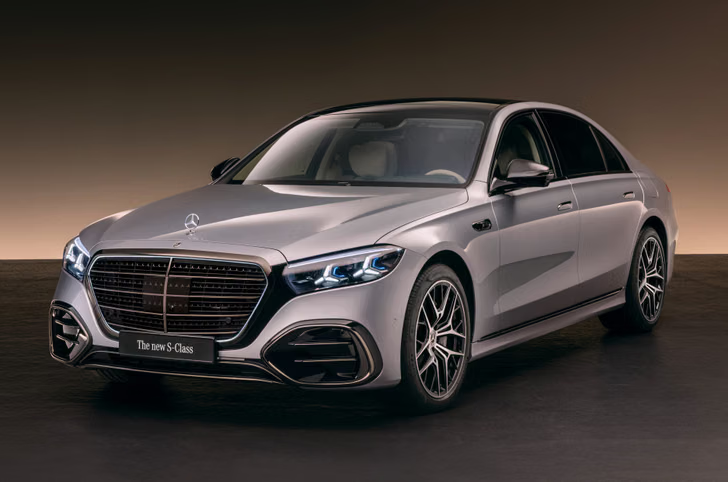
The automaker’s recent unveiling of the updated S-Class and Mercedes-Maybach S-Class in Seoul underscores that reality. While global debuts took place earlier in Stuttgart and Beijing, bringing the models to Korea signals the country’s strategic weight in the brand’s high-end portfolio.
South Korea ranks among the top three global markets for the S-Class and stands as the third-largest market worldwide for Maybach. Few countries combine such strong demand for both executive sedans and ultra-luxury vehicles, making Korea a rare overlap of volume and prestige.
“South Korea is one of our most important markets,” said Mathias Vaitl, pointing to the country’s highly discerning customer base and strong brand loyalty.
That demand is reflected in hard numbers. Cumulative S-Class sales in Korea surpassed 100,000 units in 2023, while Maybach sales exceeded 10,000 units last year—figures that place the country among the most influential markets for Mercedes-Benz’s flagship lineup.
The company is also tailoring its technology and features to meet local expectations. The updated S-Class integrates advanced digital systems, including AI-powered interfaces such as ChatGPT and Google Gemini, alongside comfort-focused innovations designed to enhance the in-car experience. Such features resonate strongly in a market where consumers are quick to adopt new technology and place a premium on refinement.
Beyond product, Mercedes-Benz has invested in brand experience. The Maybach Brand Center Seoul, a standalone facility in Gangnam, reflects a broader push toward personalized, high-touch engagement with customers. The reservation-only space is designed to elevate the ownership journey, reinforcing exclusivity in a market that values both status and service.
More broadly, South Korea represents a unique intersection of wealth concentration, tech-savvy consumers and a cultural emphasis on premium brands. Unlike some markets where luxury demand is fragmented, Korea offers a concentrated and highly responsive customer base—capable of influencing global perception and product strategy.
As competition intensifies in the global luxury segment, that influence matters. For Mercedes-Benz, South Korea is no longer just a strong market—it is a proving ground where brand positioning, technology adoption and customer experience are tested at the highest level.
In that context, the message is clear: any global luxury strategy that overlooks South Korea risks missing one of the most dynamic and demanding markets in the world.