
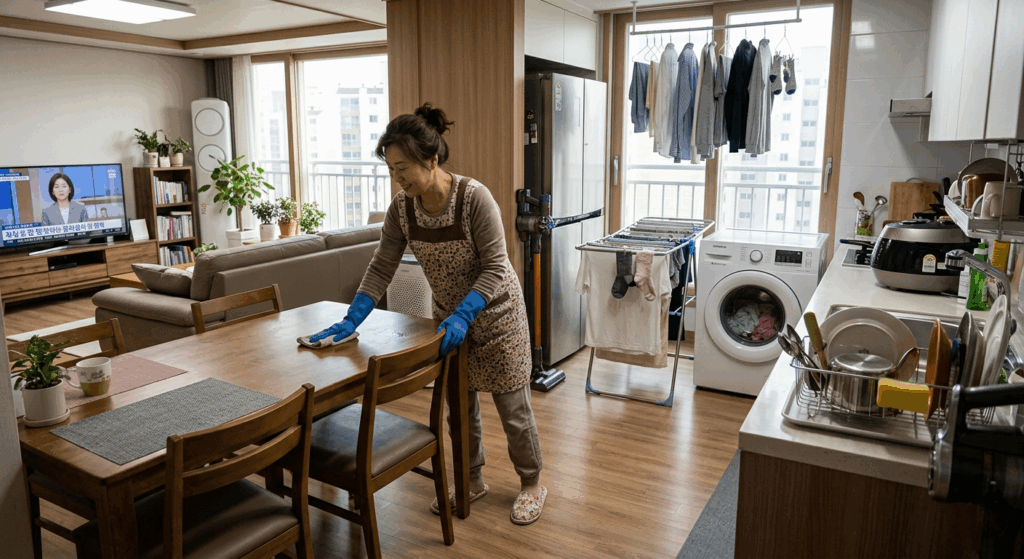
As advanced economies grapple with how to better measure economic activity beyond traditional gross domestic product metrics, South Korea is emerging as one of the most proactive countries in assigning formal economic value to unpaid household labor.
Through an increasingly detailed statistical framework, South Korea is placing a monetary value on domestic work—including cooking, cleaning, caregiving and household management—highlighting the significant role non-market labor continues to play in the broader economy.
According to Statistics Korea, the estimated value of unpaid household production reached approximately $390 billion in 2024, equivalent to about 22.8% of the country’s nominal GDP. The figure was calculated using the nation’s “household production satellite account,” a system that converts time spent on domestic tasks into economic value based on replacement wage methodologies.
The initiative reflects South Korea’s broader effort to more comprehensively assess economic productivity, particularly as demographic shifts, automation and labor-market changes reshape the boundaries between formal and informal economic activity.
Over the past five years, the total economic value of unpaid housework increased by roughly 20%, even as its share of GDP declined modestly from 23.8%. That shift suggests that while household labor remains substantial, market-based economic sectors are expanding more rapidly, and certain domestic functions are increasingly being outsourced to paid services such as food delivery, caregiving and home-management platforms.
Average daily time spent on unpaid housework declined to 132 minutes per person in 2024 from 137 minutes in 2019, driven by rising female labor-force participation, broader adoption of labor-saving technologies and the growing commercialization of household services.
Even with reduced time input, the financial valuation of unpaid labor rose due to higher imputed wages and broader participation. On a per-capita basis, unpaid household production now represents roughly $7,500 annually.
South Korea’s data also illustrate a gradual narrowing of one of the country’s longstanding structural imbalances: the gender gap in domestic labor.
Women’s unpaid household labor remains significantly higher, valued at roughly $11,000 annually per person compared with about $4,000 for men. However, the gap has narrowed from 3.2 times to 2.7 times over the past five years.
Men’s unpaid household labor value rose 35.7% during that period, far outpacing the 14.9% increase for women. Men now account for nearly 27% of total household production, reflecting evolving family structures, rising single-person households and shifting social expectations around domestic responsibilities.
The trend was particularly pronounced among single men, whose unpaid household labor value surged nearly 69%.
Demographic transformation is also reshaping the composition of unpaid labor itself. South Korea’s aging population, declining birthrate and expansion of one-person households are shifting household production away from child care and toward adult caregiving, home management and even pet-related responsibilities.
The value of unpaid labor among one-person households rose more than 66% over five years, while adult caregiving increased more than 20%, underscoring how social and population changes are redefining household economic structures.
South Korea’s aggressive approach to quantifying unpaid labor positions it at the forefront of a broader global conversation about how economies should value productivity beyond conventional markets.
For policymakers and economists, the country’s model offers a clearer view into the “hidden economy” that underpins daily life—one increasingly shaped by gender convergence, technological substitution and demographic change.
As the definition of economic productivity continues to evolve, South Korea’s framework suggests that measuring unpaid labor may become an increasingly important tool for understanding the full scope of national economic performance.