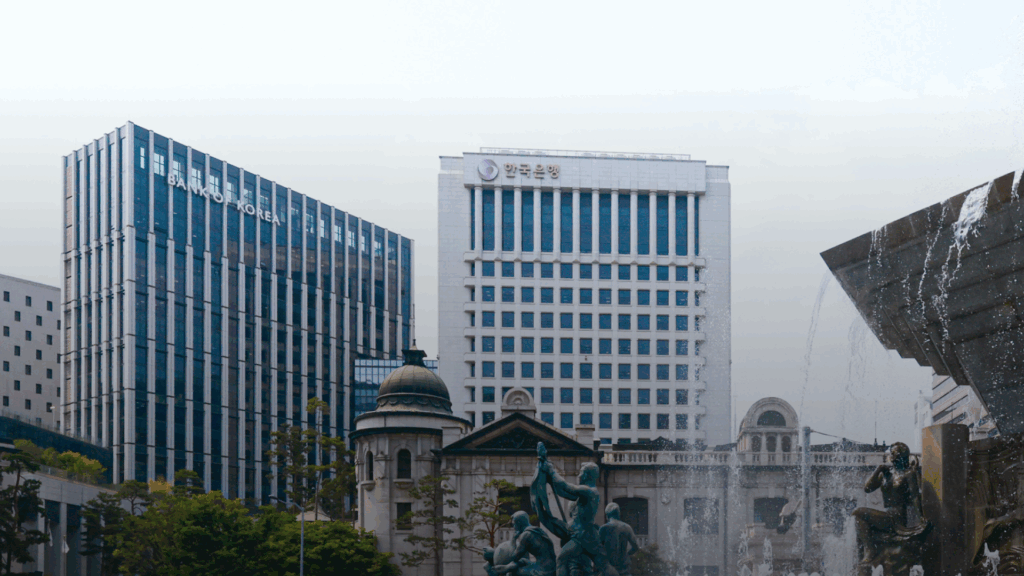
Just months after investors expected interest-rate cuts across Asia, South Korea is beginning to confront a different problem: inflation may be returning faster than policymakers anticipated.
The Bank of Korea is widely expected to keep its benchmark interest rate unchanged at 2.50% on Thursday, extending a pause that has lasted nearly a year. But economists increasingly believe the central bank may use the decision to prepare markets for a possible return to tighter monetary policy later this year.
The shift reflects how quickly the economic backdrop has changed in one of the world’s most trade-dependent economies. South Korea, home to major semiconductor exporters including Samsung Electronics and SK Hynix, had spent much of the past year battling slowing growth, weak domestic demand and pressure to support the economy through lower borrowing costs.
Now the country is facing the opposite risk.
Oil prices have remained elevated as the Middle East conflict stretches into its third month following U.S. and Israeli strikes on Iran earlier this year. The prolonged uncertainty has pushed up transportation and raw-material costs across Asia while reviving fears of a second wave of global inflation.
South Korea has been particularly exposed because of its dependence on imported energy and export-driven manufacturing. Producer prices rose 2.5% in April from a year earlier, marking the steepest increase since the Asian financial crisis in 1998. Raw-material costs surged 28.5%, the largest increase since the country began compiling the data in 1980.
Consumer inflation has also accelerated beyond the central bank’s target. After stabilizing near 2% earlier this year, headline inflation climbed to 2.6% in April, led by rising petroleum prices.
At the same time, South Korea’s economy has proven unexpectedly resilient thanks to another rebound in semiconductor demand tied to artificial intelligence infrastructure and global data-center investment. First-quarter economic growth reached 1.7%, nearly double the central bank’s earlier forecast.
The stronger growth has complicated the policy outlook for Governor Shin Hyun-song, who is presiding over his first monetary policy meeting as head of the central bank. Markets are closely watching whether he signals that the Bank of Korea is shifting away from a defensive stance focused on supporting growth and back toward containing inflation.
The issue extends beyond South Korea’s domestic economy. As one of the world’s largest semiconductor exporters and a critical supplier within global technology supply chains, South Korea is often viewed by investors as an early indicator of broader manufacturing and trade cycles.
That makes the country’s inflation problem difficult for global markets to ignore.
The Korean won has also come under renewed pressure as the interest-rate gap between South Korea and the United States remains wide. After briefly recovering earlier this month, the currency weakened again toward 1,520 won per dollar as foreign investors resumed selling Korean equities.
A weaker won increases the cost of imports, intensifying inflation pressure at a time when policymakers are already struggling to stabilize prices.
Meanwhile, rising apartment prices in Seoul are reviving concerns about asset bubbles returning to the country’s housing market. Low borrowing costs, combined with recovering investor sentiment, have contributed to accelerating home-price gains in some of the capital’s most expensive districts.
Analysts now expect the Bank of Korea to leave rates unchanged while adopting a more hawkish tone, signaling that additional easing is unlikely unless global conditions deteriorate sharply.
The message would represent a notable reversal from earlier expectations that Asian central banks would soon follow the U.S. Federal Reserve into a broader easing cycle. Instead, South Korea may now be emerging as one of the first major economies confronting the possibility that the global inflation fight is not yet finished.