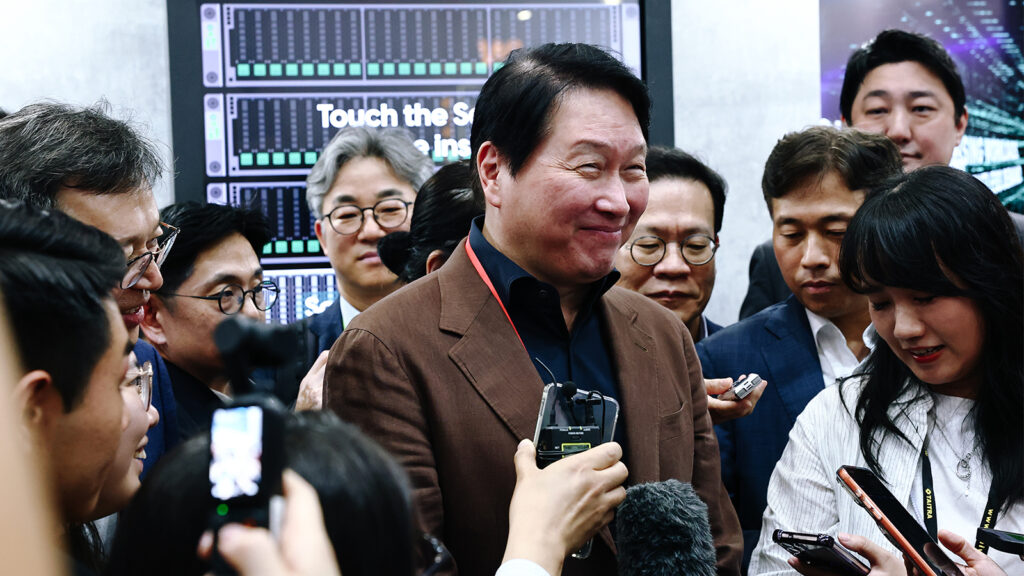
SK Group Chairman Chey Tae-won is pushing one of the most ambitious artificial-intelligence initiatives yet proposed by a major industrial company, calling for every employee to be paired with a dedicated AI agent as South Korea’s second-largest conglomerate accelerates its transformation into an AI-native enterprise.
The proposal, unveiled during SK Group’s annual New Icheon Forum, reflects how some of South Korea’s largest corporations are moving beyond AI experimentation and attempting to embed the technology directly into daily operations, decision-making and management processes.
SK Group, the sprawling conglomerate behind memory-chip maker SK Hynix, telecommunications provider SK Telecom and energy company SK Innovation, occupies a strategic position in the global AI supply chain. The company supplies high-bandwidth memory chips used in advanced AI systems while also operating businesses tied to data centers, telecommunications networks and energy infrastructure.
Chey argued that the next phase of corporate AI adoption will require more than employees using individual chatbot tools. Instead, companies must develop AI systems capable of working alongside employees, analyzing operational data and improving organizational performance.
He proposed a “one AI agent per employee” model, describing it as a transition from personal AI assistants to shared AI systems designed to support teams and entire business units. Chey said he plans to create multiple AI agents himself and use them to communicate with executives and employees across SK’s various affiliates.
The initiative comes as companies around the world search for ways to translate rapid advances in generative AI into measurable productivity gains. While many firms have introduced AI tools for coding, research and administrative work, large-scale deployment across entire organizations remains relatively rare.
For SK, the strategy is closely tied to its broader belief that artificial intelligence will reshape multiple industries simultaneously. During the forum, Chey highlighted what he described as the group’s full-stack exposure to the AI economy, spanning memory semiconductors, data-center infrastructure, power resources and electrification technologies.
That positioning has become increasingly important as global demand for AI infrastructure surges. SK Hynix, a key supplier of high-bandwidth memory chips used in AI accelerators, has emerged as one of the biggest beneficiaries of the AI investment boom, helping elevate the group’s profile within the technology sector.
Chey framed the challenge not as a technology upgrade but as an operational transformation. He argued that companies capable of improving execution and decision-making through AI will be better positioned to navigate future disruptions and capitalize on new business opportunities.
The urgency of that message was evident throughout the three-day forum, which focused exclusively on artificial intelligence for the first time since the event was launched in 2019. AI itself played a visible role in the discussions, with an AI agent named “Sky” providing real-time summaries of executive conversations and virtual AI-generated panelists participating alongside human employees.
The gathering underscored a broader shift taking place inside South Korea’s corporate sector. As global technology leaders race to build the infrastructure powering artificial intelligence, the country’s largest conglomerates are increasingly focused on a different question: how to transform themselves into organizations run with AI at their core rather than simply supported by it.