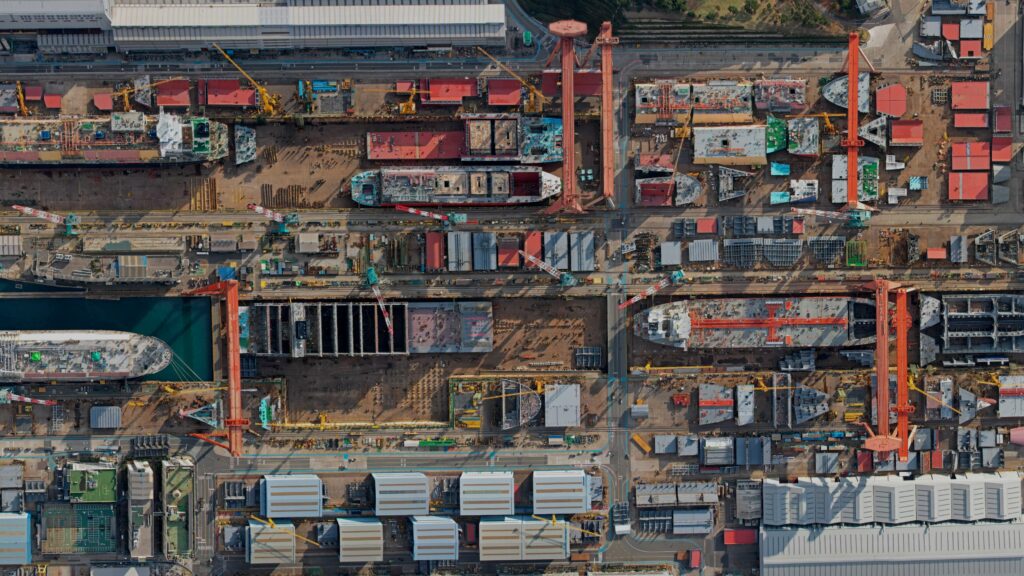
A surge in global demand for liquefied natural gas carriers is reshaping the shipbuilding market, helping South Korea narrow its gap with China by focusing on higher-value vessels tied to energy transport.
Global ship orders reached 4.06 million compensated gross tons, or 135 vessels, last month, up 31% from a year earlier, according to U.K.-based Clarkson Research.
South Korea secured 1.59 million CGT, accounting for 39% of total orders, while China led with 2.15 million CGT, or 53%. The gap narrowed sharply from February, when China held 80% of orders compared with South Korea’s 11%.
The shift reflects differences in what each country builds. South Korean shipyards averaged 42,000 CGT per vessel, about 1.6 times higher than China’s 26,000 CGT, pointing to a concentration in more complex, higher-value ships.
Demand has been driven by a wave of LNG project development and fleet replacement cycles, both of which favor advanced vessels typically built by South Korean yards.
At the same time, tensions linked to Iran and the disruption of traffic through the Strait of Hormuz have pushed up demand for very large crude carriers, supporting order prices and volumes in the segment.
LNG carriers are currently priced at about $248 million, while ultra-large container ships reach $260 million. Very large crude carriers stand at roughly $130 million, up from the previous month.
The latest data points to a bifurcating shipbuilding market, where China dominates volume production while South Korea gains ground in high-margin segments tied to global energy logistics.