South Korea’s two biggest memory-chip makers are tightening their grip on the global semiconductor supply chain, reinforcing the country’s role as a critical supplier to the artificial-intelligence boom reshaping the U.S. technology industry.
Samsung Electronics, South Korea’s largest technology company and the world’s biggest memory-chip maker, held 38% of the global DRAM market by revenue in the first quarter, according to Counterpoint Research. SK Hynix, another South Korean memory-chip manufacturer and Samsung’s closest domestic rival, ranked second with 29%, while U.S.-based Micron Technology held 22%.
The figures show that Samsung has regained momentum in the broader DRAM market after trailing SK Hynix during the first half of last year. SK Hynix led the market in the first and second quarters of last year, before the two companies tied at 33% in the third quarter. Samsung moved back into first place in the fourth quarter and extended its lead in the first quarter, widening the gap with SK Hynix to nine percentage points from four percentage points three months earlier.
The rebound comes as global demand for memory chips accelerates alongside investment in AI servers and data centers. Counterpoint said the overall DRAM market grew 80% from the previous quarter and surged 260% from a year earlier, reflecting a sharp recovery from the downturn that hit the memory industry before the AI spending boom took hold.
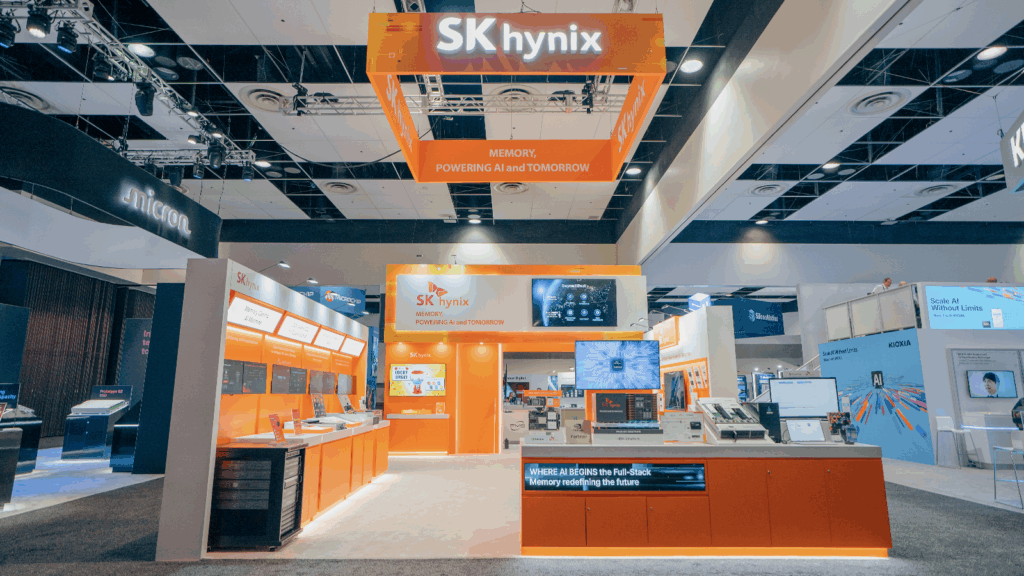
But the most important battlefield is no longer conventional DRAM alone. In high-bandwidth memory, or HBM, a specialized type of memory stacked vertically and used alongside advanced AI processors, SK Hynix remains the dominant player. The company held 58% of the HBM market in the first quarter, compared with 21% each for Samsung and Micron.
That split matters for U.S. investors and technology companies because HBM has become one of the most important components in AI accelerators used by companies such as Nvidia. SK Hynix’s leadership in HBM has made it a key beneficiary of the AI infrastructure boom, even as Samsung retains the stronger position in the broader DRAM market.
Samsung is now trying to narrow that gap. Counterpoint said Samsung is expected to expand its HBM position after beginning initial supplies of HBM4, its next-generation high-bandwidth memory, to Nvidia. Broader HBM4 shipments are expected to gather pace in the second half of the year.
The competition is also drawing in China. ChangXin Memory Technologies, or CXMT, increased its DRAM market share to 8% in the first quarter from 3% a year earlier. In NAND flash memory, China’s Yangtze Memory Technologies Co., or YMTC, expanded its share to 13% from 8% over the same period, helped by tighter supply and rising prices.
Samsung remained the world’s largest NAND flash supplier with a 29% share. SK Hynix followed with 18%, while Japan’s Kioxia held 14%. Micron, SanDisk and YMTC each accounted for 13%.
The latest numbers point to a semiconductor market increasingly shaped by two forces: the AI-driven demand surge led by U.S. chip designers and cloud companies, and China’s push to build a larger domestic memory industry. For now, South Korea remains at the center of that contest, with Samsung defending its global memory crown and SK Hynix holding the lead in the AI memory segment that has become one of the industry’s most strategic markets.