As smoking rates fall across developed economies and regulatory pressure intensifies worldwide, South Korea’s largest tobacco company is increasingly repositioning itself around emerging markets as it seeks new avenues for long-term growth.
KT&G, long dominant in its home market, is accelerating its strategic pivot away from domestic dependence and toward Southeast Asia, Central Asia and Latin America—regions where tobacco demand remains comparatively resilient despite broader global declines in cigarette consumption.
The shift underscores a growing divide within the global tobacco industry. While smoking rates continue to decline in the U.S. and Europe due to public-health campaigns, ESG investment pressures and tighter regulation, many developing economies continue to offer more stable consumption patterns driven by population growth and less restrictive policy environments.
For KT&G, those structural market changes are becoming central to its future.
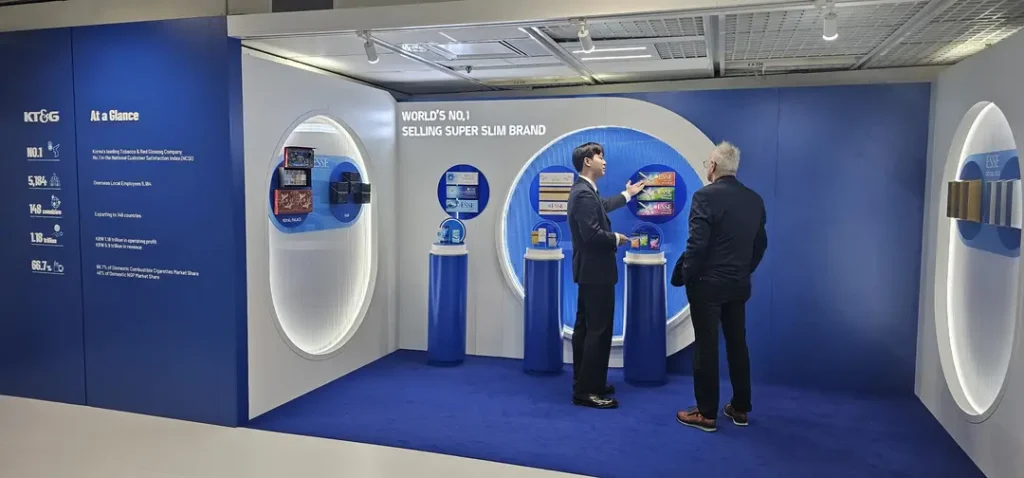
The company said overseas cigarette sales accounted for more than half of total cigarette revenue last year for the first time in its history, reaching approximately $1.2 billion—an increase of 29.4% from the previous year. International markets represented 54.1% of total cigarette sales, signaling that the company’s global diversification strategy is beginning to materially reduce its reliance on South Korea.
KT&G has spent years building manufacturing and distribution capabilities designed to capitalize on that transition.
The company currently operates production facilities in Türkiye, Russia, Indonesia and Kazakhstan, with an additional factory in Surabaya, Indonesia, scheduled to begin operations later this year. Once fully operational, KT&G’s overseas production network is expected to reach roughly 35 billion cigarettes annually, significantly improving cost competitiveness and supply-chain efficiency in fast-growing markets.
Beyond manufacturing, KT&G is also moving away from a distributor-heavy export model toward localized direct sales operations. The company maintains overseas sales subsidiaries in six countries and plans to launch its first Latin American branch in Guatemala this year, creating a strategic foothold for regional expansion.
The strategy reflects a broader trend among South Korean consumer companies that are increasingly localizing production and supply chains in response to geopolitical uncertainty and evolving global trade patterns.
KT&G’s ambitions also extend beyond traditional combustible cigarettes.
Its heated tobacco platform, “lil,” is now sold in 34 countries through a strategic partnership with Philip Morris International, while last year’s acquisition of a Swedish nicotine pouch manufacturer expanded KT&G’s exposure to smokeless nicotine products—one of the fastest-growing segments in developed nicotine markets.
Industry analysts view KT&G as a case study in how legacy tobacco companies can respond to structural declines in smoking by diversifying geographically and technologically.
Rather than retreating alongside shrinking developed-market demand, KT&G is leveraging emerging-market expansion and alternative nicotine categories to reposition itself as a broader global nicotine consumer-products company.
For investors, the strategy may help insulate KT&G from long-term declines in traditional smoking while opening new revenue streams in less saturated markets.
More broadly, KT&G’s global repositioning illustrates how South Korean corporations are increasingly extending their reach beyond traditional export strengths such as semiconductors and automobiles into mature global consumer sectors historically dominated by Western multinationals.
In an era of declining global smoking prevalence, KT&G’s transformation may ultimately serve as a blueprint for how established tobacco players adapt to survive—and grow—through one of the industry’s most significant structural shifts.