Kang Seong-cheol, chief executive of Daedong Robotics, is betting that combining artificial intelligence with robotics—what he calls “physical AI”—can help tackle chronic labor shortages in agriculture.
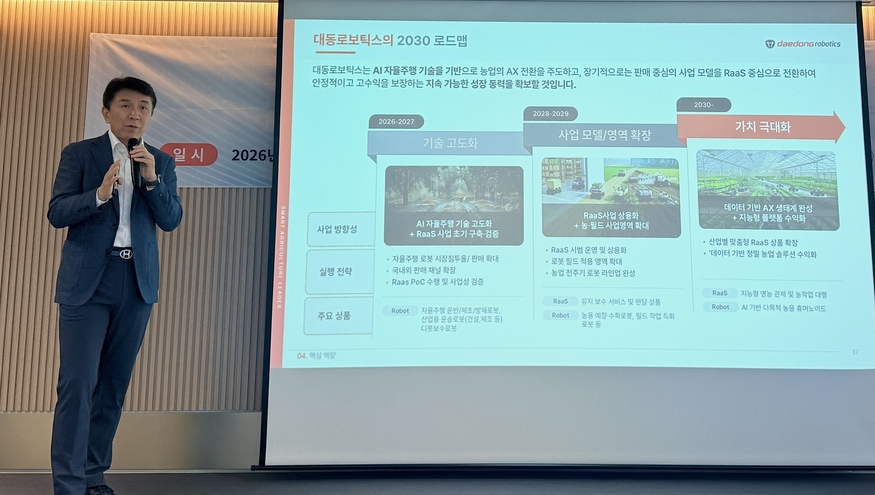
Speaking on April 29 at the company’s “2026 Daedong Tech Day,” Kang said Daedong Robotics aims to evolve beyond a machinery maker into a global provider of robotics solutions tailored to real-world farming challenges.
“Rather than simple mechanization, we are developing physical AI robots that can perceive, make decisions and operate autonomously in the field,” Kang said.
The company’s strategy is built on three pillars: AI as the “brain,” hardware as the “platform,” and software as the “service.” Kang pointed to its vision AI and multi-sensor fusion technologies, which enable precise navigation in rugged environments, as well as interfaces powered by large language models that allow farmers to control robots through voice commands.
Daedong Robotics is also developing agricultural humanoid robots and expanding a robotics-as-a-service model, targeting aging rural populations and shrinking labor pools. The effort is part of a broader push toward AI-driven agriculture.
Kang said the company generated about $1.9 million in revenue last year and is targeting roughly $3.8 million this year. It is expanding across business-to-consumer and business-to-government agricultural segments, while also entering nonagricultural business-to-business markets. The company plans to bundle its robots with AI-powered tractors from its parent to boost sales.
Separately, Daedong is set to take a leading role in a government-backed smart agriculture project in South Korea, alongside LG CNS and other partners.
The project, with a total budget of about $1.9 billion, includes plans to build an advanced greenhouse complex spanning roughly 53 acres and to establish a testbed for autonomous farming technologies. About $850 million in government funding has already been allocated for the initial phase.
Daedong will focus on deploying autonomous agricultural machinery and robotics for unmanned operations, while LG CNS will develop the data platform infrastructure.
To support its longer-term ambitions, Daedong Robotics recently expanded its workforce to around 40 employees and split operations into two divisions: a product development unit focused on mass production and a newly established platform division in Seoul dedicated to next-generation technologies, including humanoid robotics and advanced manipulation capabilities.
Kang, a former head of robotics at Samsung Electronics, said the move offered a clearer path to commercialization.
“Large companies have strong development infrastructure, but the process of bringing products to market can be complex,” he said. “Agriculture offers clear demand and a strong opportunity to scale robotics into a viable business.”
Daedong Group also plans to transform its dealership network into full-service providers offering integrated solutions and subscription-based services, aiming to build a more sustainable agricultural ecosystem.