Samsung Electronics has surpassed a $750 billion market capitalization, becoming the first South Korean company to reach the milestone, as it steps up efforts to reassert leadership in artificial intelligence and advanced semiconductors.
The move comes amid improving investor sentiment toward AI-related technologies and follows recent industry recognition. Jensen Huang, chief executive of NVIDIA, recently praised Samsung’s next-generation memory, leaving a handwritten “Amazing” note on an HBM4 wafer during the company’s GTC 2026 event.
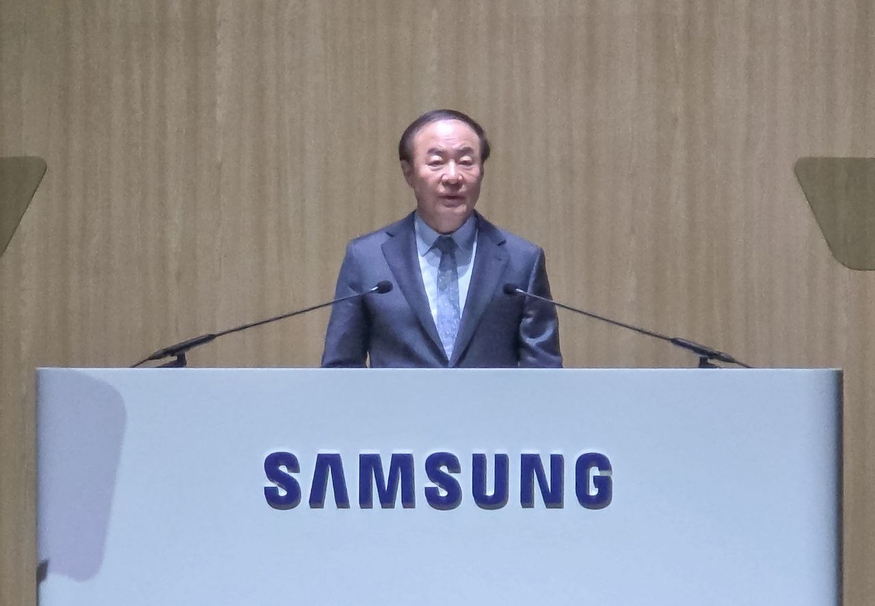
At its annual shareholders meeting on March 18, Samsung laid out a broad strategy spanning AI chips, mobile devices and robotics, signaling a renewed push across key technology segments.
Vice Chairman Jun Young-hyun said the company posted record annual revenue of about $250 billion despite macroeconomic uncertainty. He added that Samsung aims to lead the transition to AI through advanced products and services. The company also confirmed annual shareholder returns of roughly $8.3 billion, including an additional $1 billion payout.
A central pillar of Samsung’s 2026 strategy is integrating memory, foundry and chip design into a “one-stop solution.” The company highlighted its HBM4 and next-generation HBM4E products, combining advanced DRAM processes with its 4-nanometer foundry technology to strengthen its position as an integrated semiconductor supplier.
Samsung said it will extend its lead in next-generation manufacturing with gate-all-around technology and accelerate its transition to 2-nanometer chips, targeting demand from AI data centers and robotics. Its system semiconductor division is advancing on-device AI capabilities through the Exynos 2600 processor and ISOCELL HP5 image sensor.
On the consumer side, Samsung is pushing to expand so-called “agentic AI” across devices and services. Mobile chief Roh Tae-moon said the company plans to double its Galaxy AI installed base to 800 million devices by 2026, up from 400 million in 2025, supported by new flagship models and form factors.
Samsung is also increasing investment in robotics, with plans to deploy high-precision humanoid robots in its manufacturing operations before expanding into commercial markets. In home appliances, the company is strengthening its AI-powered Bespoke lineup and targeting cooling solutions for AI data centers following its acquisition of FläktGroup.
The shareholder meeting included expanded engagement, featuring a live Q&A session with executives and technology demonstrations, including high-end audio systems from Bowers & Wilkins and transparent micro-LED displays.
The developments underscore Samsung’s effort to position itself at the center of the global AI ecosystem as it seeks to translate technological advances into sustained market leadership.