
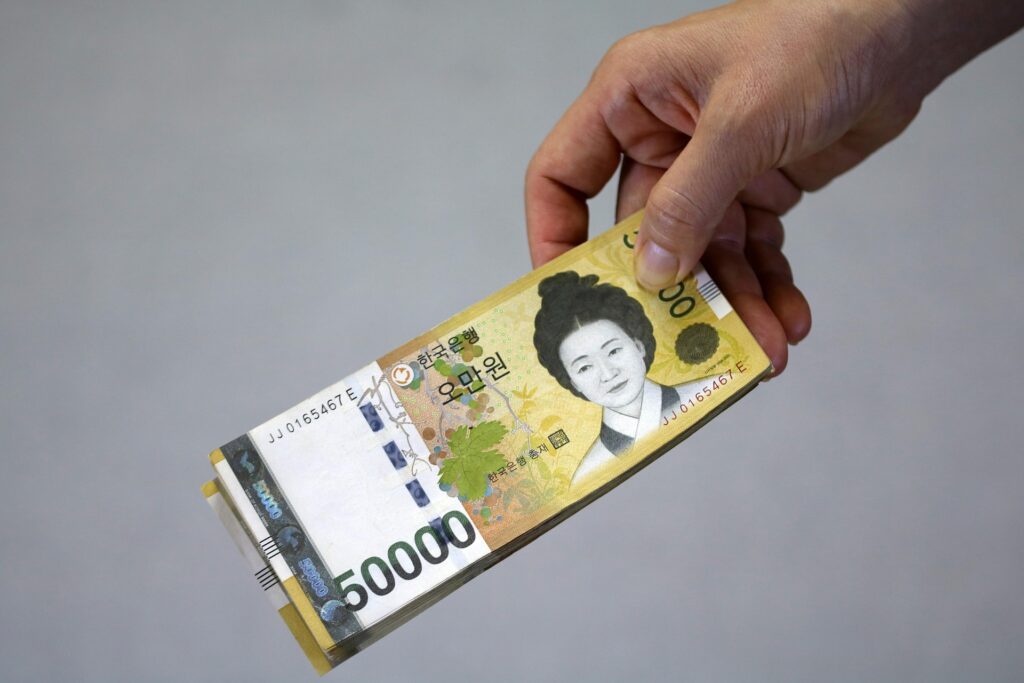
South Korea’s economy, which had only recently shown signs of recovery, is confronting renewed pressure as the won weakens toward $1 = 1,500 won, a level not seen in months. While the immediate impact is domestic, analysts warn that the currency’s slide has broader implications for global investors and supply chains.
During trading this week, the won–dollar rate climbed above $1 = 1,480 won, its highest in eight months, amid foreign capital outflows from South Korean equities. Net selling by international investors has added downward pressure on the currency, prompting authorities to activate a currency swap arrangement with the National Pension Service to stabilize the market, though details on timing and scale remain undisclosed.
Bank of Korea Governor Rhee Chang-yong cautioned that the situation is not a traditional financial crisis but poses significant risks to the real economy. A weaker won raises import costs for energy, raw materials, and intermediate goods, which could translate into higher consumer prices and weaker domestic demand.
The effects are uneven. Export-oriented conglomerates may gain competitiveness abroad, but small and medium-sized companies and import-reliant firms face profit pressures. Increased exchange-rate volatility could also affect foreign investor confidence, potentially accelerating capital outflows from both equities and bonds.
Industry experts note that South Korea’s heavy reliance on dollar-denominated imports leaves its economy sensitive to currency fluctuations. Even with stable global commodity prices, a weaker won can independently drive up costs, which may ultimately feed into inflation and impact companies engaged in international trade.
For global investors, the won’s volatility is a signal to monitor South Korea’s markets closely. Funds with exposure to Korean equities or bonds may face heightened risk, while multinational companies trading with Korean suppliers could encounter cost pressures.
The Bank of Korea faces a delicate balancing act: stabilizing prices while maintaining market confidence. With the won near historic lows, economists say the currency’s movements have become a key factor shaping not only Korea’s economic trajectory but also the considerations of international investors with stakes in the region.