SK On, a South Korean battery maker best known for supplying electric-vehicle batteries to global automakers, is moving into the defense sector as it seeks new growth engines beyond a slowing EV market—marking a rare push by a Korean company to compete in military-grade energy systems.
The company, an affiliate of SK Group, is in talks with U.S. and European defense contractors to supply high-performance batteries for unmanned and autonomous military platforms, according to people familiar with the matter. The discussions include potential applications in AI-powered unmanned underwater vehicles, vertical takeoff and landing aircraft, helicopters and military cargo planes.
SK On’s expansion highlights a broader strategic shift among South Korean industrial firms, which are increasingly leveraging advanced manufacturing and battery technology to enter defense supply chains traditionally dominated by U.S. and European players.
Defense applications demand batteries with an uncommon mix of high energy density, strong power output and exceptional safety—requirements that go well beyond those of passenger electric vehicles. Unmanned submarines, autonomous ground vehicles and aerial systems must operate for extended periods while also delivering short bursts of power for maneuvering, communications and onboard weapons systems.
Reliability is paramount. Military equipment must function under extreme conditions, including shock, vibration and wide temperature swings, making safety validation and long-term durability essential hurdles before deployment.
Industry analysts say SK On is likely to rely initially on its ultra-high-nickel lithium-ion batteries, a technology it has refined through years of supplying global automakers. Over the longer term, the company is positioning all-solid-state batteries as a potential breakthrough for defense platforms, where space constraints and safety risks are particularly acute.
Because military batteries require extensive testing and certification, commercial-scale supply is unlikely to materialize before 2028, analysts say.
Still, SK On has already secured an early foothold. The company supplies battery cells to Hyundai Rotem, a South Korean defense manufacturer, for a next-generation multipurpose unmanned ground vehicle program. Hyundai Rotem integrates the cells into battery modules and packs and is currently conducting field trials, according to industry sources.
Hyundai Rotem has been developing AI-based autonomous driving and swarm-control technologies for its unmanned platforms, including the HR-Sherpa series, as South Korea accelerates investment in defense automation and unmanned warfare capabilities.
SK On’s ambitions in defense are closely tied to its progress in solid-state battery technology. Unmanned military systems face severe space and weight constraints while requiring high output and stringent safety standards—conditions where solid-state batteries could offer decisive advantages once commercialized.
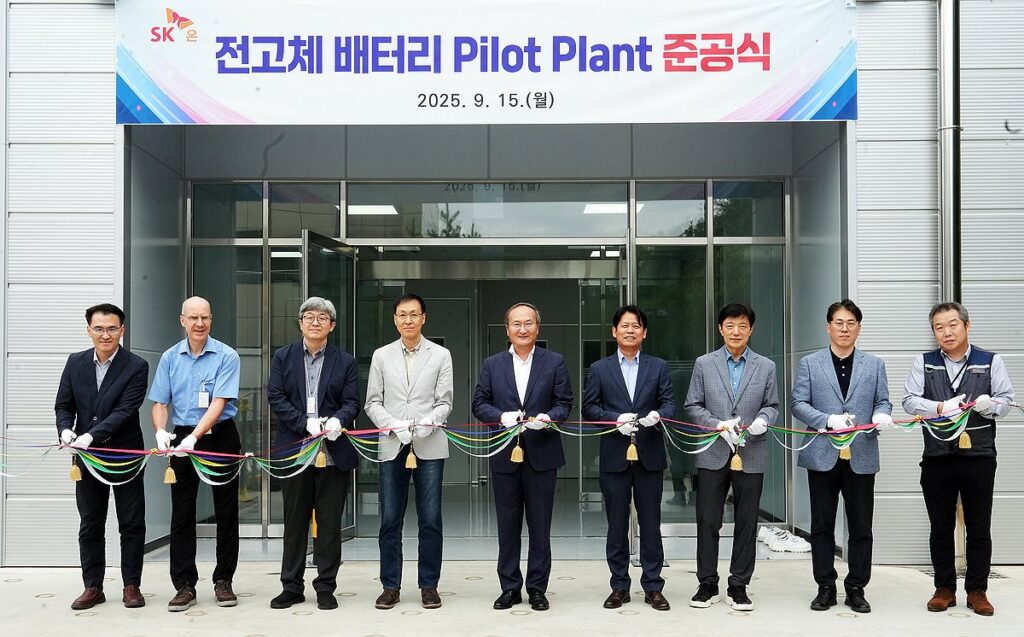
The company has set 2029 as its target for solid-state battery commercialization and has built a pilot production line at its research center in Daejeon. Its development efforts focus on sulfide-based solid-state batteries and lithium-metal designs.
SK On is also collaborating with U.S.-based solid-state battery specialist Solid Power, combining its own manufacturing expertise with Solid Power’s cell design and sulfide electrolyte technology to accelerate development.
“The rapid evolution of unmanned defense systems and physical AI platforms is pulling forward demand for next-generation batteries,” said a battery-industry executive. “Companies that establish credibility in defense applications early will be well positioned as these systems move toward large-scale deployment.”
For SK On, the move into defense represents both a hedge against volatility in the EV market and a strategic bet that South Korea’s battery expertise can translate into influence in one of the world’s most tightly controlled and security-sensitive industries.