Netflix’s global rankings this week offered another signal of how thoroughly Korean entertainment has entered the mainstream of international streaming. A Korean reality series and a Korean film each held the No. 1 position in Netflix’s non-English categories for a second consecutive week, a result that underscores the durability of demand for Korean content across regions and genres.
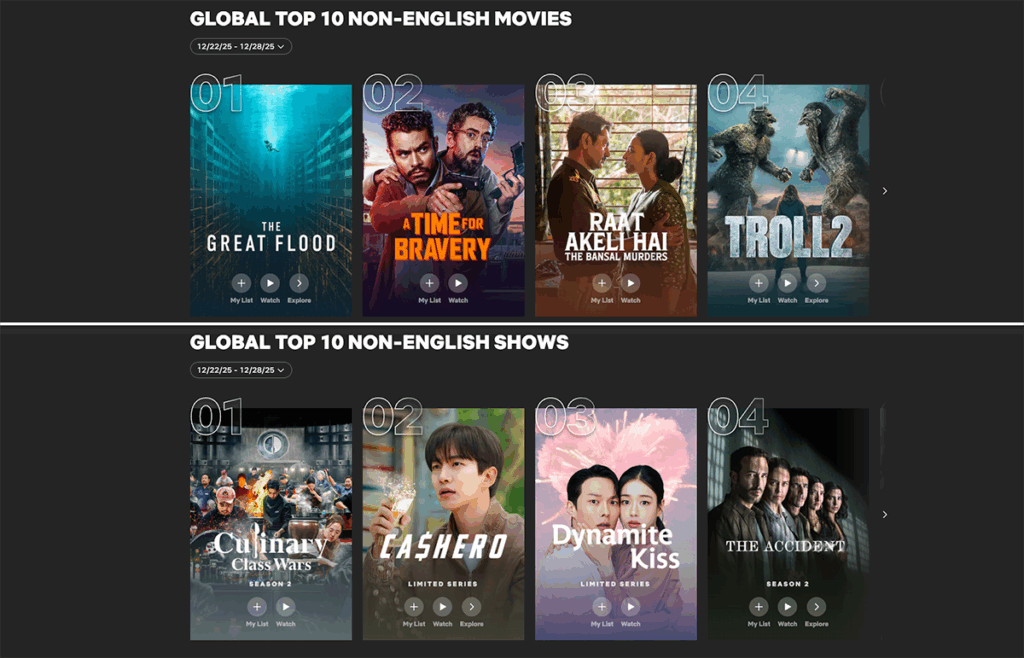
According to data released on Dec. 31 by Netflix through its Tudum analytics site, the cooking competition series “Culinary Class Wars 2” ranked first among non-English television shows, while the film “The Great Flood” led the non-English movies chart. Netflix measures views by dividing total hours watched by a title’s runtime, allowing comparisons across formats.
“Culinary Class Wars 2” drew 4.7 million views during the week. The show, which stages head-to-head culinary battles between Michelin-recognized celebrity chefs and lesser-known but highly skilled competitors, ranked No. 1 in South Korea, Hong Kong, Singapore, and Taiwan, and placed within the top 10 in 16 countries overall. Its first season became the first Korean variety program to hold the global non-English No. 1 spot for three straight weeks, and the second season has now maintained the lead since its release.
“The Great Flood,” meanwhile, expanded its reach despite uneven critical reception. The film recorded 33.1 million views last week, surpassing its opening-week performance. Initially framed as a disaster movie before pivoting toward science fiction themes involving artificial intelligence and motherhood, the film ranked No. 1 in 53 countries, including the United States, France, Spain, Japan, and Saudi Arabia, and appeared in the top 10 in 92 countries worldwide.
On the U.S. review site Rotten Tomatoes, the movie holds a critics’ score of 50 out of 100 and an audience score of 34. The contrast between those ratings and its strong viewership reflects a broader pattern in global streaming, where curiosity and algorithmic discovery often drive consumption more than critical consensus.
Beyond these two titles, several other Korean series clustered near the top of Netflix’s non-English rankings, reinforcing the sense that Korean content is no longer reliant on a single breakout hit. Reality shows, scripted dramas, and feature films from South Korea now circulate simultaneously across markets, suggesting sustained engagement rather than episodic interest.
For Netflix, the results support a long-term strategy centered on heavy investment in local production paired with immediate global distribution. For the broader entertainment industry, they illustrate how K-content has moved past its early novelty phase and into a more stable role within global viewing habits, where language is increasingly secondary to format, genre, and storytelling.