For many American travelers, a first trip to South Korea still revolves around Seoul. The capital’s neighborhoods, shopping districts, and food culture dominate guidebooks and social media feeds. But new tourism data suggest that this long-standing pattern is beginning to loosen, with foreign visitors gradually adding destinations beyond the capital to their itineraries, influenced by pop culture and major international events.
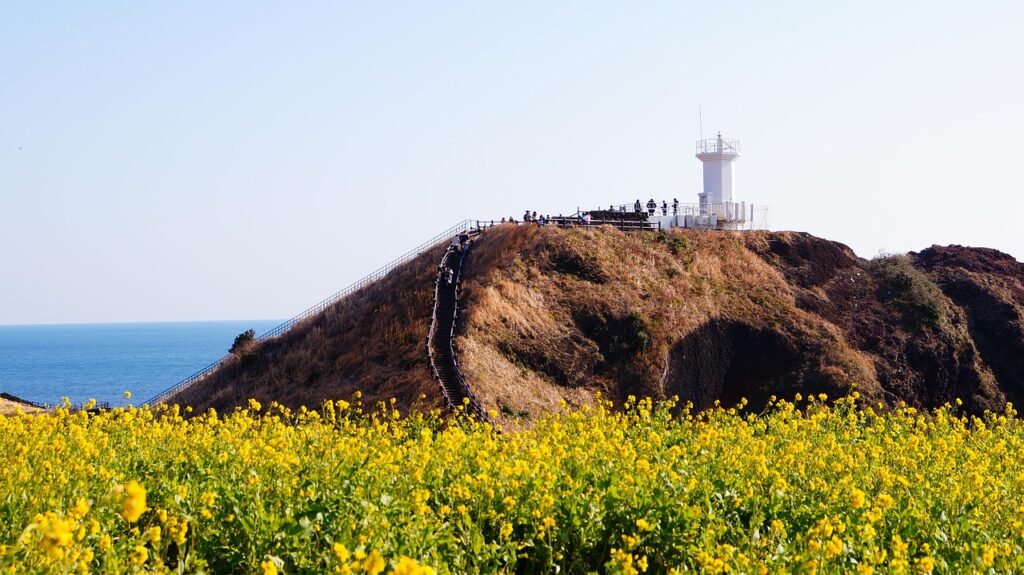
Jeju Island has emerged as one of the clearest examples of that shift. According to the Korea Culture and Tourism Institute, the share of foreign visitors who traveled to Jeju rose steadily this year, reaching 10.5% in the third quarter, up from 9.9% for all of last year. The increase remains modest in absolute terms, but it stands out in a tourism landscape long dominated by the Seoul metropolitan area.
Tourism analysts in Korea cite the international popularity of the television drama When Life Gives You Tangerines as one contributing factor. Set largely on Jeju Island, the series brought the island’s volcanic coastlines and rural villages to global audiences, turning once-familiar domestic scenery into recognizable locations for overseas viewers.
The timing supports that view. Data from the Korea Tourism Data Lab show that foreign arrivals to Jeju began rising in April, shortly after all episodes of the drama were released, reversing declines earlier in the year. Growth continued through the summer, suggesting that screen exposure translated into travel decisions rather than short-lived online interest.
This phenomenon fits into a broader pattern of cultural spillover that has become increasingly visible to American viewers. As Korean pop music, films, and series circulate globally on streaming platforms, from chart-topping bands to animated features like KPop Demon Hunters, they are not just exporting stories but quietly reshaping perceptions of place. Locations once peripheral to foreign itineraries are becoming destinations in their own right, discovered first on screen and only later on a map.
Other regions have benefited from different forms of international exposure. In North Gyeongsang Province, foreign visitor rates rose in the third quarter alongside growing attention linked to the Asia-Pacific Economic Cooperation summit held in the historic city of Gyeongju at the end of October and beginning of November.
Even before the APEC leaders were set to arrive in Gyeongju in late October, the region was already seeing an uptick in foreign visitors, as advance delegations, planners, and event-related travelers began flowing in months ahead of the summit.
In South Gyeongsang Province, the rebound has been driven less by diplomacy than by logistics. The recovery of cruise tourism centered on Busan has begun to extend outward, drawing foreign visitors to nearby coastal cities such as Tongyeong and Geoje through longer, multi-stop itineraries and regionally linked travel packages.
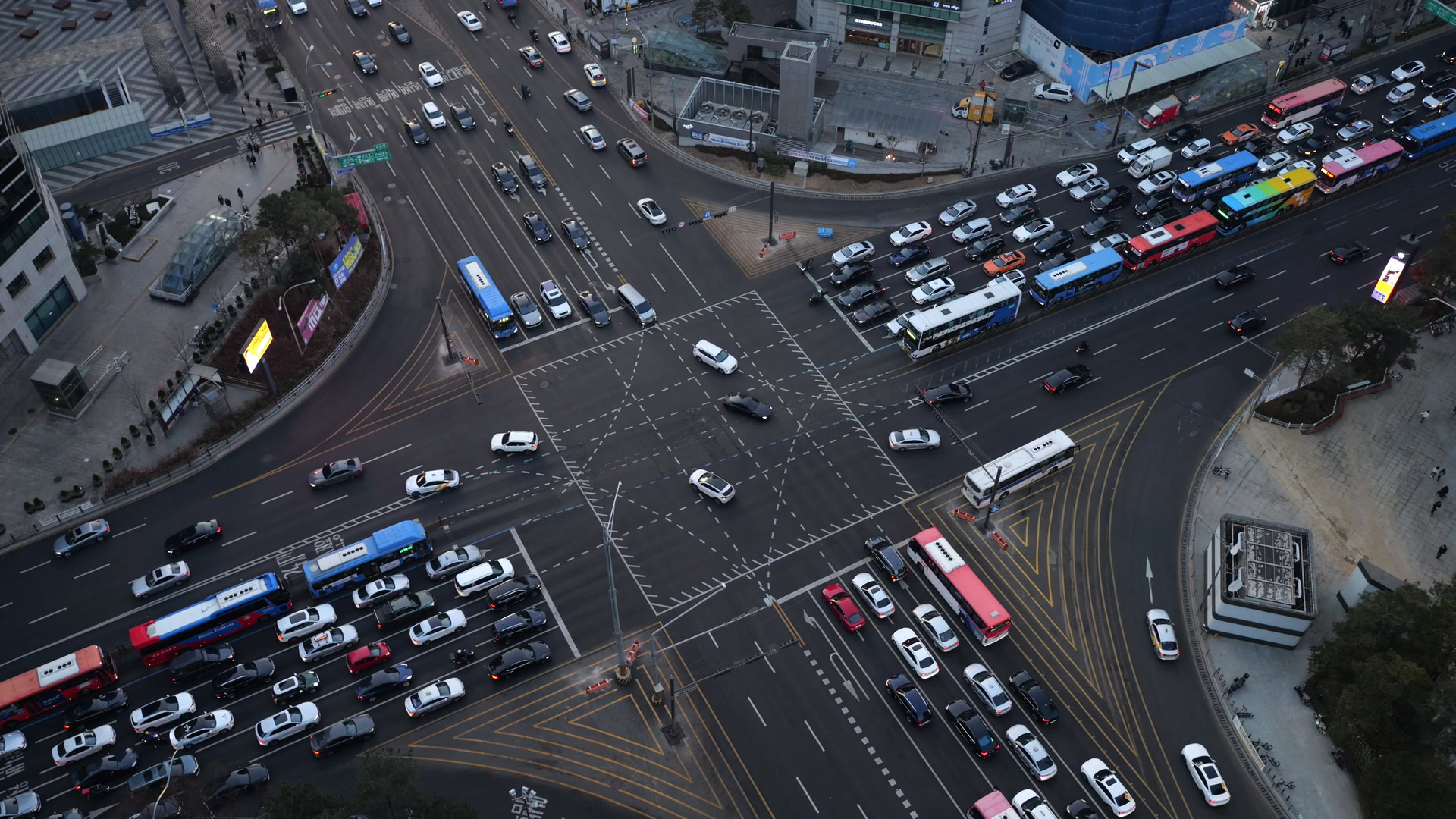
Yet for all these shifts, Seoul’s gravitational pull remains overwhelming. In the third quarter, 77.3% of foreign visitors traveled to the capital, only slightly below last year’s level and far ahead of any other destination. Much of the modest redistribution has flowed not to distant provinces but to neighboring Gyeonggi, where day trips and short overnight stays fit easily into Seoul-based itineraries. Together, Seoul and Gyeonggi accounted for 88.6% of foreign visits, underscoring how concentrated inbound tourism remains.
For policymakers and tourism officials, the data point to both opportunity and constraint. Korean pop culture and international events can nudge travelers beyond the capital, but structural habits are slow to change. For American visitors, the story is less about abandoning Seoul than about discovering that the Korea they recognize from screens and headlines extends further than they once imagined.
In South Gyeongsang Province, the rebound has been driven less by diplomacy than by logistics. The recovery of cruise tourism centered on Busan has begun to extend outward, drawing foreign visitors to nearby coastal cities such as Tongyeong and Geoje through longer, multi-stop itineraries and regionally linked travel packages.
Yet for all these shifts, Seoul’s gravitational pull remains overwhelming. In the third quarter, 77.3% of foreign visitors traveled to the capital, only slightly below last year’s level and far ahead of any other destination. Much of the modest redistribution has flowed not to distant provinces but to neighboring Gyeonggi, where day trips and short overnight stays fit easily into Seoul-based itineraries. Together, Seoul and Gyeonggi accounted for 88.6% of foreign visits, underscoring how concentrated inbound tourism remains.
For policymakers and tourism officials, the data point to both opportunity and constraint. Korean pop culture and international events can nudge travelers beyond the capital, but structural habits are slow to change.
For American visitors, Seoul remains the anchor. What is changing is that more trips now stretch outward, as destinations once familiar only from screens begin to appear on travel plans.