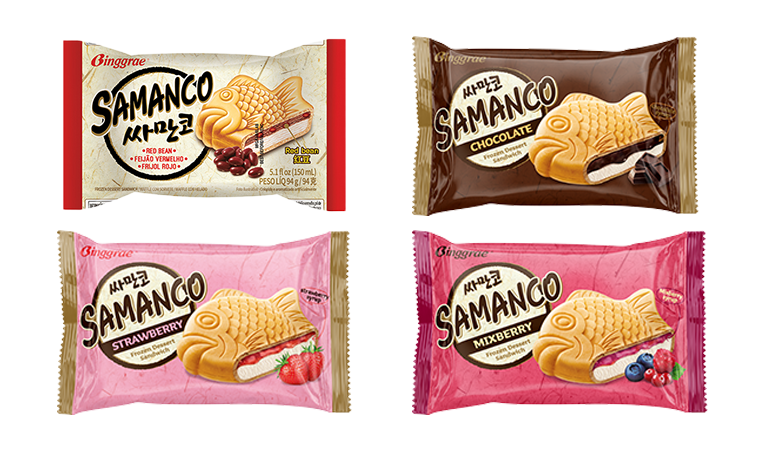
Costco’s freezer aisles are emerging as an unexpected gateway for Korean food companies seeking scale in the U.S. market. Recent sales rankings suggest that Korean frozen snacks are moving beyond niche appeal and beginning to establish themselves as mainstream products inside America’s largest warehouse retailer.
Two Korean-made desserts—Samanco waffle cone ice cream sandwiches from Binggrae and custard-filled walnut pastries from Pulmuone—ranked among Costco’s top-selling new frozen food launches nationwide this week, according to the retailer. The performance places Korean brands alongside established Western players and signals growing acceptance of K-food within U.S. mass retail.
For overseas food producers, Costco represents one of the most demanding proving grounds. Shelf space in frozen categories is limited, volumes are high and underperforming items are quickly rotated out. Industry executives say early success at Costco is often interpreted as evidence that a product can sustain repeat purchases, not merely attract one-time curiosity.
That distinction is critical for Korean brands historically concentrated in Asian grocery channels. Strong rotation at Costco suggests that Korean frozen foods are increasingly being evaluated—and purchased—by mainstream American consumers on the same terms as domestic products.
Samanco’s performance illustrates that shift. The product’s fish-shaped waffle cone provides visual differentiation, but its flavors—such as chocolate and strawberry—remain familiar to U.S. palates. Costco-focused social media accounts highlighted the item’s family-sized multipack and accessible pricing, factors that align with the retailer’s core customer base. Consumer feedback has framed Samanco less as an imported novelty and more as a repeat-buy freezer staple.
Pulmuone’s walnut pastries have followed a similar path. The frozen dessert combines custard cream and walnuts within a soft cake exterior, positioning it closer to conventional frozen bakery items than to specialty ethnic snacks. Reviews frequently describe the product as suitable for everyday consumption, a key requirement for longevity in big-box retail.
The sales results are already shaping corporate strategy. Binggrae, which exports Samanco to markets across Asia, Oceania and Latin America, is treating the Costco data as validation that the product can scale in U.S. mass retail. The company is expected to refine distribution and product planning based on large-retailer performance metrics rather than relying primarily on ethnic-market demand.
Pulmuone, meanwhile, is increasingly using Costco as a central pillar of its North American expansion. The company has gradually expanded its presence at the retailer with frozen and ready-to-eat offerings, and now views Korean-style snacks as a category capable of driving both revenue growth and profitability. Local production capacity has allowed Pulmuone to adjust to U.S. demand while remaining price-competitive.
The broader list of top-selling new frozen items at Costco this week included brands from France, Italy and the U.S., underscoring the degree to which Korean food companies are now competing directly with global incumbents inside America’s largest retail formats.
For Korean food makers, placement on that list carries less cultural symbolism than commercial significance. It suggests that K-food is no longer being tested as an import curiosity but is beginning to function as a scalable business within the U.S. grocery ecosystem.
At Costco, at least, Korean frozen snacks appear to have crossed an important threshold—one where U.S. growth plans can be built on sales data rather than ambition alone.