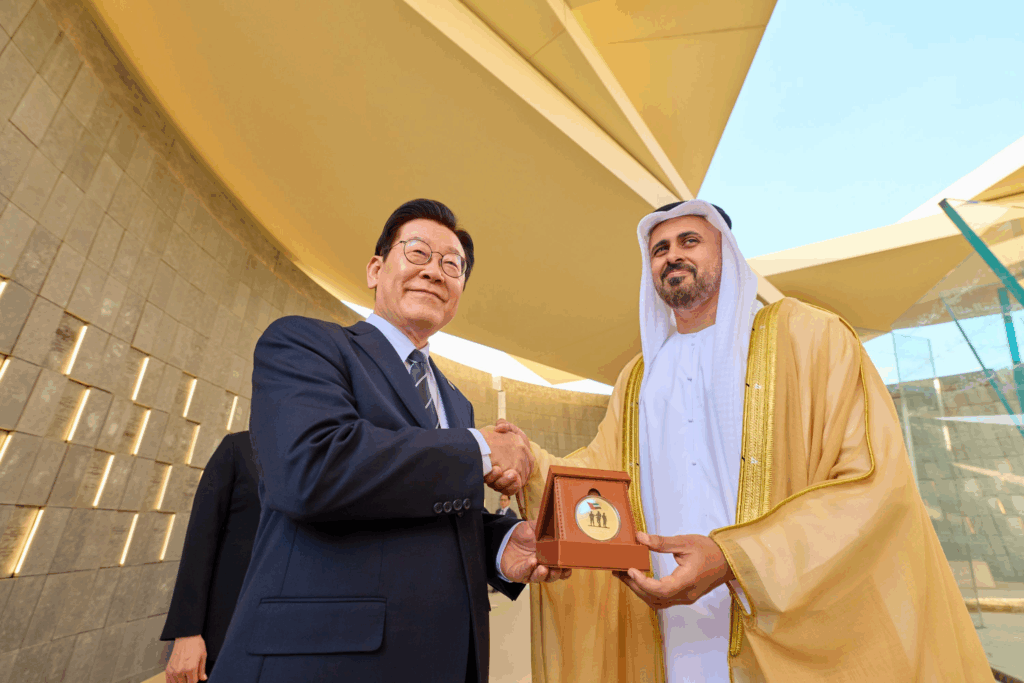
South Korea and the United Arab Emirates have signed a sweeping long-term cooperation pact that could shift competitive dynamics in several global industries closely followed by U.S. investors, including nuclear energy, defense manufacturing and artificial intelligence infrastructure.
Framed by South Korean President Lee Jae-myung and UAE President Mohammed bin Zayed as a “100-year partnership,” the agreement strengthens two close U.S. partners while creating new forces that may challenge American commercial and strategic positions worldwide.
The most immediate market implications appear in nuclear power. By committing to pursue joint export bids modeled on the Barakah project, South Korea and the UAE are effectively forming a consolidated competitor in a sector where U.S. firms already face structural pressure from state-backed players in China and Russia.
A Korean-UAE platform — offering integrated financing, construction capacity and decades-long operating support — could appeal to emerging-market governments that find U.S. offerings comparatively slower or more fragmented.
For American nuclear suppliers and investors with exposure to reactor technology, this development raises the likelihood of tighter bidding margins, more politically complex procurement processes and intensified pricing competition across Asia, the Middle East and parts of Eastern Europe.
Defense cooperation under the pact carries similar implications. The UAE’s shift from purchasing weapons to co-developing and manufacturing them locally with South Korea introduces an alternative production base in a region where U.S. defense companies have long maintained dominant market share.
As the two countries expand joint development pipelines and build out production inside the UAE, Washington’s grip on the regional defense supply chain may loosen at the margins, creating new competitive pressures for U.S. contractors.
Investors will be watching how this shapes export routes, technology standards and long-term procurement patterns across the Gulf, especially in segments such as missile systems, ground vehicles and air-defense technologies.
The technology component of the pact further underscores a changing landscape for American firms. Seoul and Abu Dhabi agreed to cooperate on building and operating AI data centers, part of a broader movement among U.S. allies to establish sovereign or hybrid digital ecosystems rather than relying exclusively on U.S.-based cloud and AI platforms.
For U.S. tech investors, this shift presents both risk and opportunity: diminished default reliance on American cloud providers could erode market share in fast-growing Middle Eastern digital economies, yet the acceleration of regional AI deployment could boost demand for U.S.-made semiconductors, networking equipment and software tools that underpin high-performance data centers.
Taken together, the Korea–UAE pact signals the emergence of a more coordinated industrial and technological partnership with the potential to reshape pricing, procurement and investment flows across several sectors where the United States has traditionally enjoyed strong influence.
For U.S. investors, the agreement represents both a competitive challenge and a strategic indicator — a sign that allied nations are beginning to build parallel capabilities that will require closer attention as global markets, supply chains and security alliances continue to evolve.