Electric vans are no longer a niche experiment for delivery companies and service fleets. In the United States and Europe, commercial buyers are increasingly focused on operating costs, adaptability, and durability as electrification accelerates across logistics and service industries.
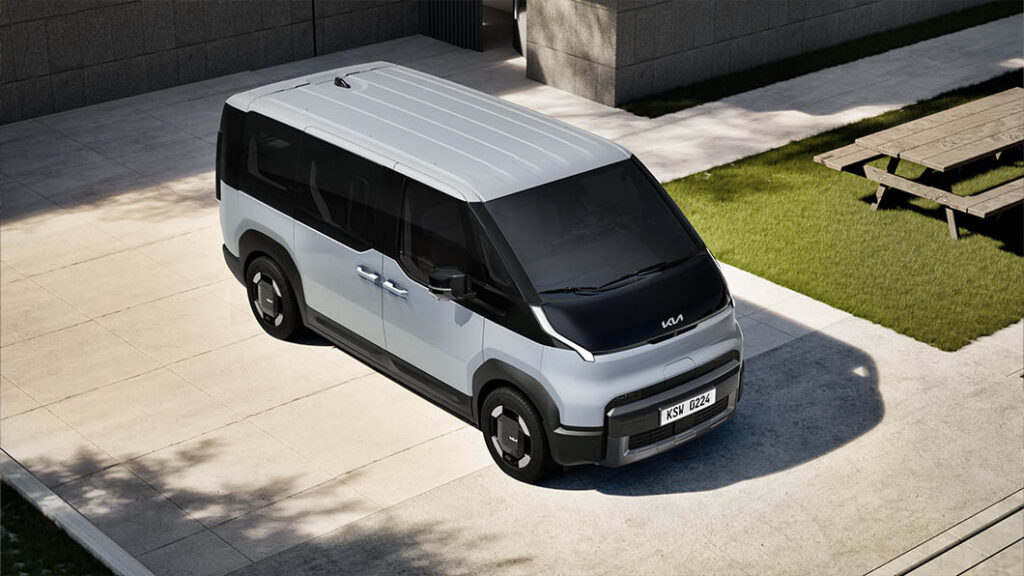
That shift has begun to shape industry recognition overseas. Kia, a South Korean automaker that has steadily expanded its presence in the U.S. market over the past decade with mass-market sedans and sport utility vehicles, has seen its first fully electric purpose-built commercial vehicle, the PV5, named Van of the Year by Electrifying.com, News UK, and Parkers. The model is not currently sold in the United States, and Kia has not announced U.S. launch plans.
While Kia is best known to American consumers for models such as the Sportage and Telluride, the company has a longer history in commercial vehicles outside the United States, particularly in Asia. The PV5 reflects an effort to translate that commercial experience into the electric era through a platform designed specifically for work vehicles rather than adapted from passenger cars.
In the U.S., the electric van segment has largely been defined by Ford’s E-Transit, Rivian’s commercial van, and General Motors’ BrightDrop lineup. These vehicles are evaluated less on brand identity than on how efficiently they can be deployed across delivery routes, utility services, and fleet operations. Conversion flexibility and total cost of ownership have become decisive factors as fleets scale electrification.
Those same considerations shaped the European evaluations that elevated the PV5. Electrifying.com, which emphasizes real-world usability and ownership economics, described the vehicle as “a model that opens a new chapter in the electric van market,” citing its modular electric architecture and conversion-friendly design.
The PV5 also received top honors at the 2025 News UK Motor Awards for its operating efficiency and practicality. At the 2026 Parkers Van and Pickup Awards, it won both Van of the Year and Best Electric Van, with reviewers highlighting driving range, cargo access, and interior space.
Kia says the vehicle reflects a development process centered on commercial users rather than retail buyers. The company worked with more than 100 customer organizations globally and tested over 1,000 real-world usage scenarios during development. That approach led to a dedicated electric platform for purpose-built vehicles, known as E-GMP.S, along with a flexible body system and a commercial-focused infotainment system based on Android Automotive OS.
The PV5 is not positioned as an imminent entrant into the U.S. market. Instead, it illustrates how electric vans are evolving as automakers move away from passenger-car adaptations and toward vehicles engineered from the outset for commercial use.