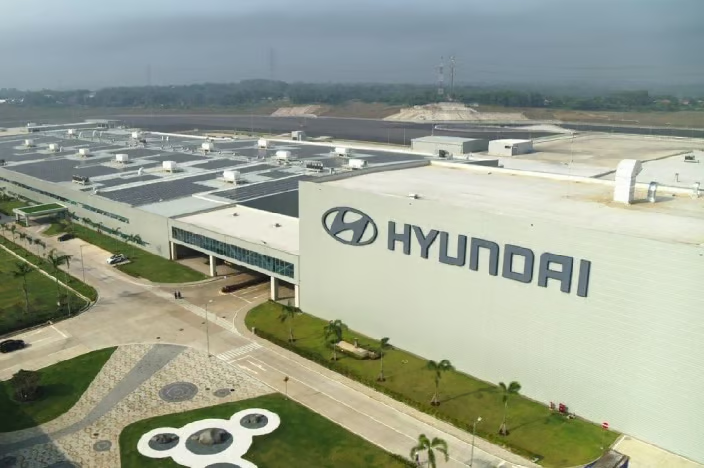
Hyundai Motor Group’s decision not to exercise its buyback option on its former Russian manufacturing plant is fueling speculation that the South Korean automaker may be closing the chapter on Russia—at least for the foreseeable future.
The group confirmed earlier this month that it would not repurchase its flagship St. Petersburg factory, a move that effectively rules out a near-term return to a market once considered a cornerstone of Hyundai’s global growth strategy. The decision comes as geopolitical risks tied to the war in Ukraine remain unresolved and Western sanctions continue to constrain business activity in Russia.
Hyundai exited Russia in December 2023, selling 100% of its local operations—including the St. Petersburg plant—to Russian firm Art-Finance for a symbolic price of roughly $110. The transaction included a two-year buyback option, widely viewed at the time as a hedge against a potential easing of sanctions or a diplomatic breakthrough.
By letting that option lapse, Hyundai is signaling a reassessment of risk that goes beyond short-term operational challenges. Instead of preparing for reentry, the company says it will focus on servicing existing customers in Russia, maintaining warranty repairs and after-sales support for vehicles already on the road.
The shift marks a notable reversal for an automaker that once ranked Russia among its most profitable overseas markets. Hyundai entered Russia in 2007 and opened its St. Petersburg plant in 2010, tailoring vehicles such as the Solaris (Accent), Creta SUV and Kia Rio to local driving conditions. Those models helped Hyundai and Kia capture a combined 23.6% market share in 2021, with annual sales reaching a record 377,600 vehicles.
That momentum came to an abrupt halt after Russia’s invasion of Ukraine in 2022. Production was suspended in March of that year as sanctions disrupted supply chains and made continued operations untenable. After nearly two years of inactivity, Hyundai opted for a full exit rather than an indefinite wait-and-see approach.
Industry analysts say the decision underscores how the strategic calculus for global automakers has changed. “The longer the war drags on, the higher the political and reputational risks of returning,” said one automotive industry official. “For Hyundai, a premature move back into Russia could undermine its standing in the U.S. and Europe, markets that are far more critical to its long-term growth.”
Complicating any future return is the rapid transformation of Russia’s auto market itself. With Western brands largely absent, Chinese manufacturers have surged ahead, accounting for more than 60% of passenger-car sales in 2024, up from single digits before the war, according to data from the Korea Automobile & Mobility Association.
Hyundai has left the door technically open, saying it will continue to monitor geopolitical developments. But the company’s actions suggest that Russia, once a pillar of its Eurasian strategy, is no longer central to its global priorities.
For now, Hyundai appears to be betting that walking away—rather than waiting on uncertain diplomacy—offers greater strategic clarity in an increasingly fragmented global auto market.