Hyundai Motor Group is ramping up its cybersecurity posture, creating a centralized command center and sharply increasing security spending as automakers worldwide confront a surge in digital threats targeting connected vehicles.
The move comes as South Korea — home to Hyundai and Kia — has been hit by a series of major data breaches this year, putting pressure on large corporations to strengthen protections for customer information and digital infrastructure. The incidents have heightened scrutiny on companies seen as critical to national mobility and communications networks.
Industry officials say Hyundai recently launched a Group Cyber Threat Response Team, a new unit designed to detect vulnerabilities, coordinate incident response and enforce security standards across all Hyundai affiliates. The team is led by Ki-Chang Yang, head of the company’s Integrated Security Center. Until now, each Hyundai subsidiary had managed cybersecurity independently; the consolidation marks the company’s first group-wide structure for threat management.
Hyundai and Kia have also significantly increased their security investments. According to data from the Korea Internet & Security Agency, the companies spent roughly $46 million on information security this year — a 46% jump from 2023 and nearly triple the level in 2022. Full-time cybersecurity staffing has expanded to 262 employees, up from 185 last year.
The shift follows a string of high-profile breaches across Korea. In April, SK Telecom reported a massive leak affecting nearly all of its 23.24 million subscribers. In September, KT suffered a payments-fraud incident involving illegal micro–cell towers. Lotte Card later disclosed a breach impacting 2.97 million customers, while online retailer Yes24 was hit by ransomware that crippled its app and internal systems. Hyundai Motor Group also experienced a breach in March involving some employee information, though it said no customer or technology data was compromised.
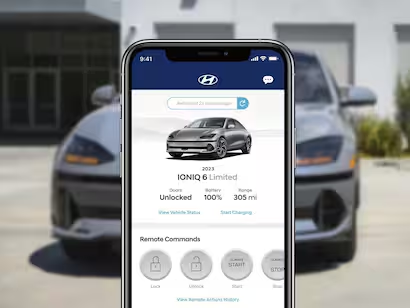
Hyundai’s heightened security posture reflects broader risks tied to the rapid rise of connected cars — vehicles that depend on continuous data exchange with cloud platforms, telecom networks and over-the-air software updates. Analysts warn that intrusions could expose personal information, disrupt vehicle-control systems or inject malicious code through remote updates, posing safety concerns for drivers and pedestrians.
One industry expert said the threat domain now stretches far beyond the vehicle itself. “A cyberattack can move from the car into cloud services and communication networks,” the expert said. “Because modern vehicles rely on constant connectivity, cybersecurity is no longer just an IT issue — it’s a consumer-safety issue.”
Hyundai’s establishment of a centralized cybersecurity hub signals a broader shift within the company: as connected-vehicle adoption accelerates worldwide, the automaker is positioning itself to stay ahead of fast-evolving digital threats — and to compete in an industry where security is becoming a defining feature of next-generation mobility.