Submarines have long been something of an afterthought in Canadian national defense policy. In the 1960s, they simply leased some from the U.S navy, before acquiring outdated Oberon-class vessels from the U.K. to maintain a bare-minimum capability.
However, the situation changed fast – Russia and China are assertively expanding their presence in the Arctic while the security umbrella formed with the U.S. began wavering. Now, even for the Canadians, submarines are no longer a good-to-have but a must-have for survival.
The CPSP(Canadian Patrol Submarine Project), the single largest procurement in the history of the Canadian navy, marks a pivotal shift – Canada has effectively declared submarines are at the core of the national defense strategy, not on the periphery.
Korea and Germany are the two remaining competitors, locked in a fierce head-to-head for the massive contract. Each side presented proposals beyond the joint national security, to a wide range of industrial cooperation spanning mining, energy and automotives.
The game is in effect a lot more than a security deal – it is a nation-to-nation pact. The Guru traveled to Canada where the final decision is soon to be made, to capture the tension on the ground – Editor’s Note
Once you pass through the departure gate at Ottawa International Airport, you cannot help but notice a huge billboard which spans an entire wall. It features two logos: one from Hanwha and the other from CAE, a global simulation company and also partner of Hanwha’s KSS-III submarine business. The ad also displays a phrase, “Canada’s premier defence partner”, which explicitly demonstrates the close tie between the two.
Founded in 1947, CAE holds an overwhelming market share in the global simulation industry. It runs approximately 40 offices around the globe, employing a total of 13k staff members. Among them, dedicated defense engineers count 1500. It partners with other multinational enterprises like Boeing, Airbus and 300 more. The Royal Canadian Navy operates vessel-related business in cooperation with CAE.
◇The Secret behind World Number 1…Complete Training Ecosystem
They were busy manufacturing simulators for civil aviation on the 10th when I visited CAE’s Montreal facility. I had a chance to experience it first-hand. I climbed up the ladder to enter a white dome – a simulator. Inside was a cockpit – or a replica down to the last bolt. The endless buttons and switches were right on point, and a panoramic front screen oversaw them all, dominating the field of vision. I am no expert in this business but could see straight away how immaculate they strive to be in remaking the flight environment as real as possible.
There are 4 seats in total. The front two are occupied by trainees, while the back row is taken by trainers, equipped with a control station. When the trainers input certain values into the machine, the training scenarios unfold in real-time. During the simulated take-off, the nose pitches up. In the maneuvering session, the entire cockpit tilts in sync with the direction. Records are digitally kept in every step, which are used to assess the trainee’s progress.
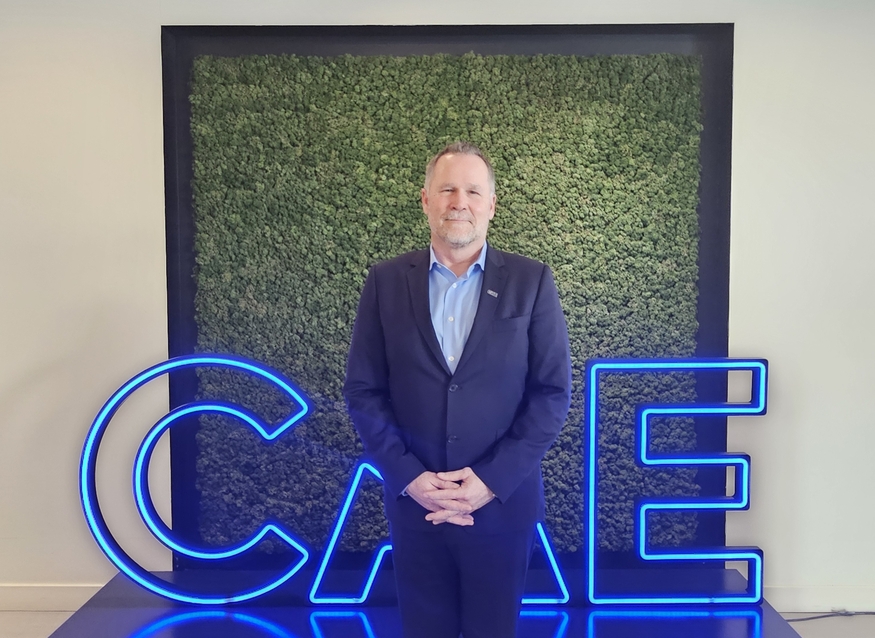
CAE’s business development director John Edelman stresses that “the core principle of any simulating system is ‘maximum realism’,” stating “a military simulation should replicate what really happens in the battlefield, and a civil simulation what really happens during the flight. Simply put, you let soldiers train as they fight, and pilots as they operate.”
CAE emphasizes ‘precision’ to make the environment as real as possible. For example, they put a model fire extinguisher inside the cockpit for a fire drill. If needed, they turn on a smoke machine so the smoke spreads like a real situation, allowing crews to practice wearing masks as well.
Interconnectivity is another competitive edge of CAE. By connecting simulators for the command room and engine room into one, the entire crew can train as if they are on the same ship. Furthermore, they can integrate weapon systems of land, sea, and air—like jets, tanks, and submarines—to perform joint operations in one shared virtual world.
◇Synergy of ‘CAE Training + Hanwha Vessel’… Cooperation Gets Real
The ultimate value CAE wants to offer is an ‘end-to-end’ training ecosystem. Director Edelman stressed, “We are not just trying to copy a specific weapon or make a simulator product. Our goal is to train individuals to operate the system safely and effectively to complete the mission.”
Before making a simulator, CAE looks closely at the customer’s training requirements. they define what kind of training and technology is needed through a ‘training needs analysis’ and then develop the courses. Based on this, they produce simulators from low-fidelity to high-fidelity, optimized for the weapon. For ships, military ones focus on combat, while civil ones focus on sea environments like weather and waves. Edelman defined this as ‘scalable and customized’ capability.
CAE is working closely with the Canadian military based on its proven global technology. Edelman explained, “CAE is a trusted training partner for the Canadian Forces. As a partner across the Army, Navy, and Air Force, we support programs like the River-class destroyer project, the largest naval procurement since WWII.”
CAE is also participating in the CPSP project in cooperation with Hanwha Ocean. After signing an MOU at the ‘Deep Blue Forum 2023,’ they moved up to a Teaming Agreement (TA) the following year. As they deepened the tie, they even visited Hanwha Ocean’s shipyard.
Edelman recalled, “I am no expert in submarines or shipbuilding, but their capability was truly amazing. The mass-production power was very impressive.”
He expressed high expectations, saying, “Hanwha’s KSS-III is a technologically advanced ship; otherwise, the Canadian military wouldn’t have considered it a candidate. By combining CAE’s training and Hanwha’s technology and operation, we can create a complementary effect.” He added, “After writing the proposal in early March, we plan to discuss more details about the actual work.”