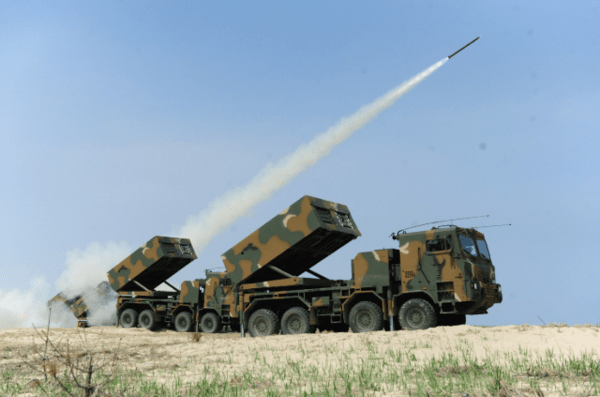
A South Korean-made rocket artillery system is gaining ground across Europe, highlighting a shift in allied defense procurement that is beginning to challenge the long-standing dominance of U.S. platforms.
At the center is Hanwha Aerospace, a major South Korean defense manufacturer, and its Chunmoo multiple launch rocket system. As demand for artillery surged following Russia’s invasion of Ukraine, European countries have faced delays and supply constraints from traditional suppliers, creating an opening for faster-moving competitors.
Poland has emerged as a key anchor in Chunmoo’s expansion. After signing major contracts starting in 2022, it has integrated the system into its artillery units and is now serving as a reference point for other buyers. Estonia, which agreed last year to purchase Chunmoo launchers and guided rockets in a deal valued at about $350 million, recently sent military officials to Poland to study how the system is deployed, trained and maintained.
That exchange reflects a broader shift. Instead of relying solely on U.S.-led systems and training frameworks, European militaries are beginning to build parallel networks around South Korean equipment, sharing operational knowledge among early adopters to speed up deployment.
Chunmoo offers a different operational profile from U.S.-made systems such as HIMARS. While the American platform is built around precision strikes with fewer rockets, Chunmoo is designed to deliver a larger volume of fire in a short period, giving it an advantage in saturation scenarios. Combined with quicker delivery timelines and more flexible contracting, that has made it increasingly attractive to countries seeking to rapidly expand firepower.
The spread of Chunmoo is also opening the door for broader adoption of South Korean systems. Discussions are already extending to the K9 self-propelled howitzer, suggesting that multiple platforms could be deployed together, strengthening interoperability among European users outside traditional supply chains.
The development does not displace U.S. systems, which remain deeply embedded across NATO. But it does mark a shift in how allies are sourcing critical weapons, with South Korea moving from a secondary supplier to a more central role in shaping Europe’s artillery capabilities.