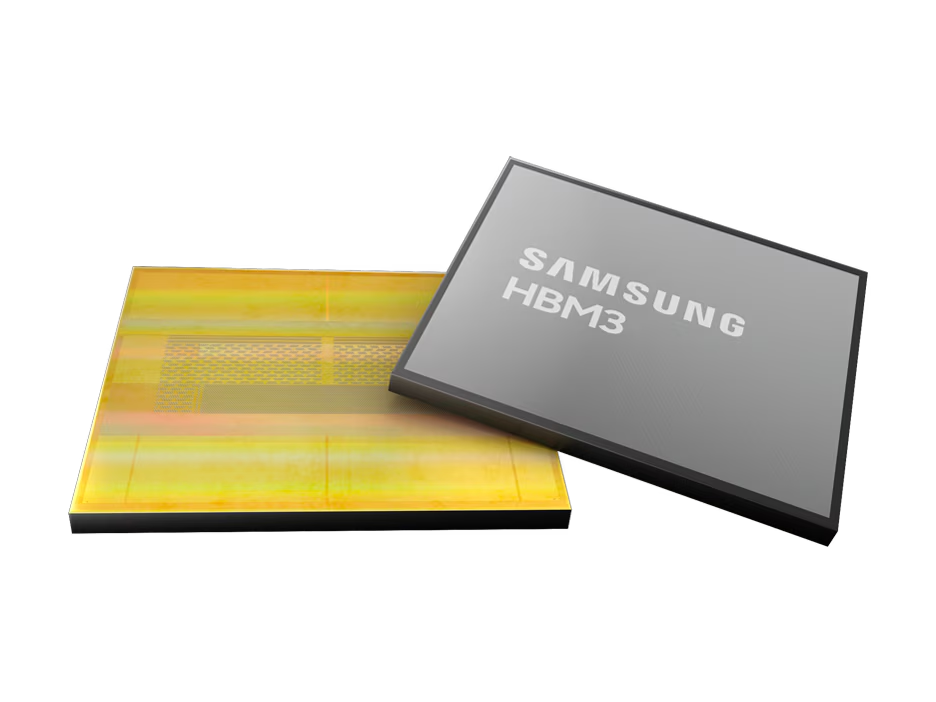
A surge in artificial intelligence spending by U.S. technology companies is reshaping the global semiconductor industry, restoring pricing power to memory suppliers and pulling Samsung Electronics, the world’s largest producer of memory chips, back into a central role after a prolonged downturn.
Samsung, the world’s largest memory chipmaker, said preliminary results showed fourth-quarter revenue of about $64 billion and operating profit of roughly $13 billion, more than triple the level recorded a year earlier. The performance marks the company’s strongest quarterly results since the last semiconductor boom in 2018 and reflects a sharp reversal from the losses and weak margins that plagued the memory industry just a year ago.
Analysts estimate that Samsung’s semiconductor division generated close to $11 billion in operating profit, accounting for nearly 80 percent of total earnings. The rebound was driven by rising prices for conventional DRAM and NAND memory, as well as a rapid expansion in shipments of high-bandwidth memory, or HBM, a specialized product that has become essential to artificial intelligence systems.
HBM has emerged as one of the most critical components in the AI supply chain. Advanced processors from companies such as Nvidia and AMD rely on large volumes of fast, power-efficient memory to train and operate large language models. As U.S. cloud providers and chip designers race to scale AI infrastructure, demand for that memory has surged, tightening supply and pushing prices sharply higher.
Industry analysts estimate that memory prices rose by roughly 50 percent in the fourth quarter. Much of that increase reflects deliberate supply discipline. Major manufacturers have reduced production of older-generation DRAM to prioritize higher-margin products such as HBM, limiting the availability of commodity memory and amplifying the effects of demand from data centers.
As the largest memory producer globally, Samsung has been particularly well positioned to benefit from this shift. The company now supplies HBM to U.S. customers including Nvidia and AMD, as well as custom-chip designers such as Broadcom, tying its earnings closely to the pace of AI investment in the United States.
At the same time, losses in Samsung’s non-memory businesses have narrowed. Analysts say improved utilization and cost controls at the company’s foundry and system chip operations have reduced their drag on overall profitability, even as those units continue to lag leading competitors.
The earnings rebound has fueled expectations that Samsung’s operating profit could more than double this year if current conditions persist. Some forecasts suggest annual operating profit could approach $69 billion, driven largely by sustained memory price strength and further growth in HBM shipments.
Attention is now turning to the next phase of the cycle. The rollout of HBM4, the next generation of high-bandwidth memory, is expected to intensify competition among global suppliers. Analysts say Samsung has made progress in qualifying its products with major customers, raising the possibility that it could gain share after trailing rivals in earlier versions of the technology.
Risks remain. Semiconductor earnings are inherently volatile, and prices remain sensitive to shifts in supply, demand and currency movements. A slowdown in AI spending or renewed capacity expansion could pressure margins. Still, industry executives argue that the current cycle differs from past booms, reflecting long-term investment in AI infrastructure rather than short-lived consumer demand.
Samsung’s results illustrate how the rapid buildout of artificial intelligence systems is redrawing the economics of the memory business, restoring profitability to a sector long defined by extreme cyclicality and placing memory suppliers back at the center of the global semiconductor industry’s growth engine.