South Korea’s food exporters have shown that cultural familiarity can travel well. Instant noodles did it first. Skincare followed. Now, bottled water is testing whether the same playbook can work in a category where branding is subtle and differentiation is notoriously hard.
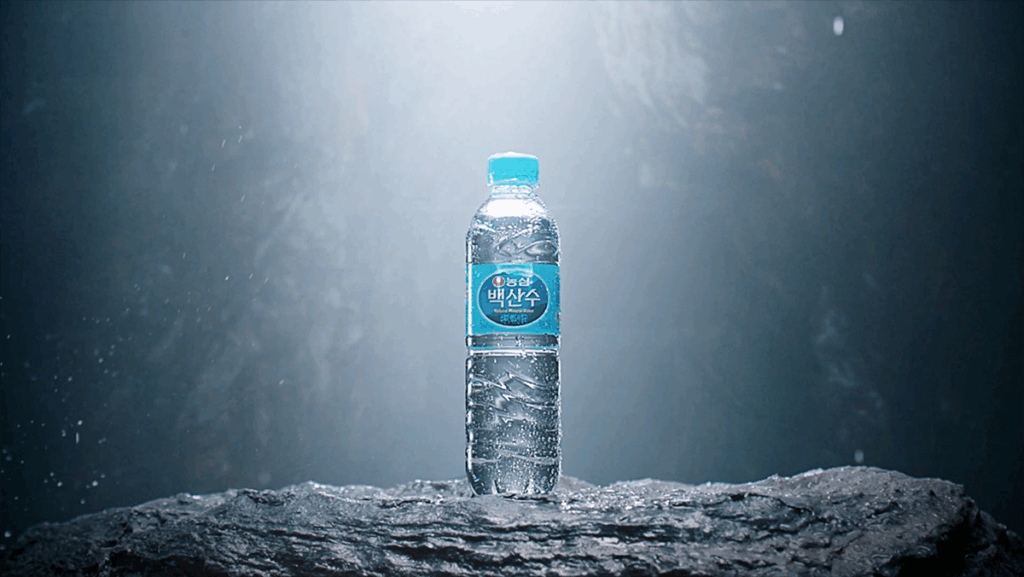
Nongshim, the country’s largest packaged-food maker by global recognition, is positioning its bottled water brand Baeksansu as a long-term international product, betting that consistency and third-party validation—not novelty—can carve out space in a crowded premium market.
The challenge is structural. Premium bottled water is dominated by incumbents from Europe and North America, where origin stories and mineral profiles have been marketed for decades. Taste claims are easy to make and difficult to verify, and consumer loyalty is fragile. For new entrants, visibility is less of a hurdle than credibility.
Nongshim’s approach has been to lean on repeatable evaluation rather than splashy launches. Baeksansu has received the International Taste Institute’s top three-star rating for four consecutive years, a distinction reserved for products scoring above 90 points in blind tastings by European sensory experts. The brand has also accumulated multiple top-tier awards from Monde Selection, another Brussels-based evaluator.
Within the industry, repeat recognition from the same panels is often seen as more meaningful than one-off accolades. In a category where quality variation can be subtle but reputational damage is not, consistency over time functions as a proxy for process discipline.
Baeksansu is sourced from underground water flows near Mount Baekdu, a site with symbolic weight in Korea but little inherent recognition abroad. To compensate, Nongshim has emphasized production controls. The water is bottled through largely automated systems designed to minimize contamination risk and batch-to-batch variation, a strategy aimed at delivering uniform quality across markets rather than highlighting terroir alone.
That emphasis reflects Nongshim’s broader export philosophy. Unlike many food brands that treat overseas markets as incremental extensions, the company has historically built products—most notably its flagship instant noodles—with global scalability in mind. Executives describe Baeksansu less as a lifestyle product and more as infrastructure: something that must perform identically regardless of where it is consumed.
Whether that approach can translate into commercial momentum remains an open question. The global bottled-water market is mature, price-competitive and increasingly scrutinized for its environmental footprint. Even premium brands face pressure from filtration systems and sustainability concerns, limiting the upside for newcomers.
Still, distributors say there is room for brands that can demonstrate reliability rather than hype, particularly in Asia and parts of the Middle East where Korean consumer goods already carry a perception of quality control. In that sense, Baeksansu is being marketed not simply as bottled water, but as “K-Water”—a product category borrowing credibility from Korea’s manufacturing reputation rather than its cultural exports.
For Nongshim, the bet is that the same attributes that made its packaged foods globally trusted—standardization, scale and process rigor—can work in a category where taste differences are narrow but trust gaps are wide.
The experiment is still early. But if K-Water is to travel the way K-food did, it will likely be less about storytelling and more about proving, year after year, that nothing changes at all.