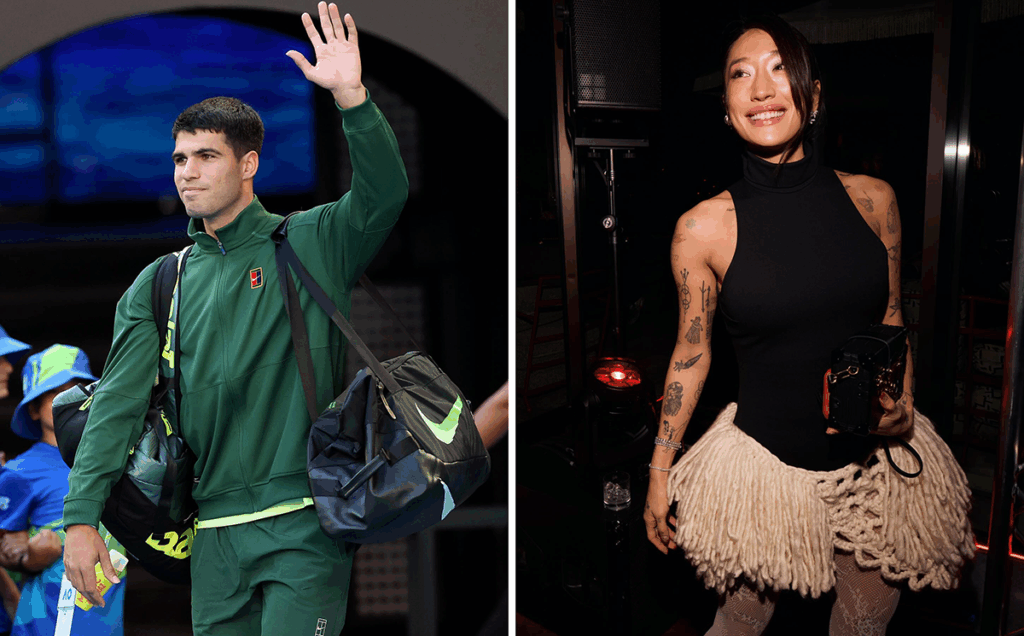
Carlos Alcaraz advanced into the Australian Open semifinals this week with the efficiency expected of the world’s top-ranked player. But moments during his latest victory shifted attention away from the scoreline and toward the stands.
As Alcaraz dispatched Australia’s Alex de Minaur in straight sets at Rod Laver Arena, television cameras repeatedly cut to his player box, where Peggy Gou—a Korean-born DJ and producer with a global following—was seated among his entourage. Her presence stood out in a venue otherwise filled with vocal support for the local favorite.
Player boxes at Grand Slam tournaments are typically reserved for coaches, family members and close confidants, making Gou’s appearance unusual. Clips of her courtside support spread quickly across social media, prompting speculation and diverting part of the post-match discussion from Alcaraz’s on-court performance to his off-court associations.
Speaking briefly after the match, Alcaraz downplayed the attention. He described Gou as a friend and said he appreciated her support, adding that if his tournament run continued, he might be able to attend her upcoming performance. He declined to elaborate further.
Gou, born in Incheon in 1991, has built an international career largely based in Europe and the U.S., headlining major clubs and performing at leading electronic music festivals.
She is scheduled to perform Sunday at the Australian Open venue as part of the tournament’s entertainment program, coinciding with the men’s singles final. Industry executives estimate her appearance fees in the high six figures, underscoring her standing among the top tier of global DJs.
The episode illustrates how major tennis tournaments have increasingly expanded beyond sport, blending elite competition with music, celebrity and lifestyle branding. The Australian Open has been particularly aggressive in positioning itself as a hybrid cultural event, using live performances and celebrity involvement to broaden its global appeal.
For Alcaraz, however, the immediate focus remains on the court. He is set to face Alexander Zverev in the semifinals as he seeks to reinforce his status as the dominant young force in men’s tennis. If he reaches the final, the tournament’s closing day would pair a championship match led by the world No. 1 with a headline performance by a Korean-born artist whose career has unfolded largely on Western stages—a convergence reflecting the increasingly globalized nature of both professional tennis and popular culture.