
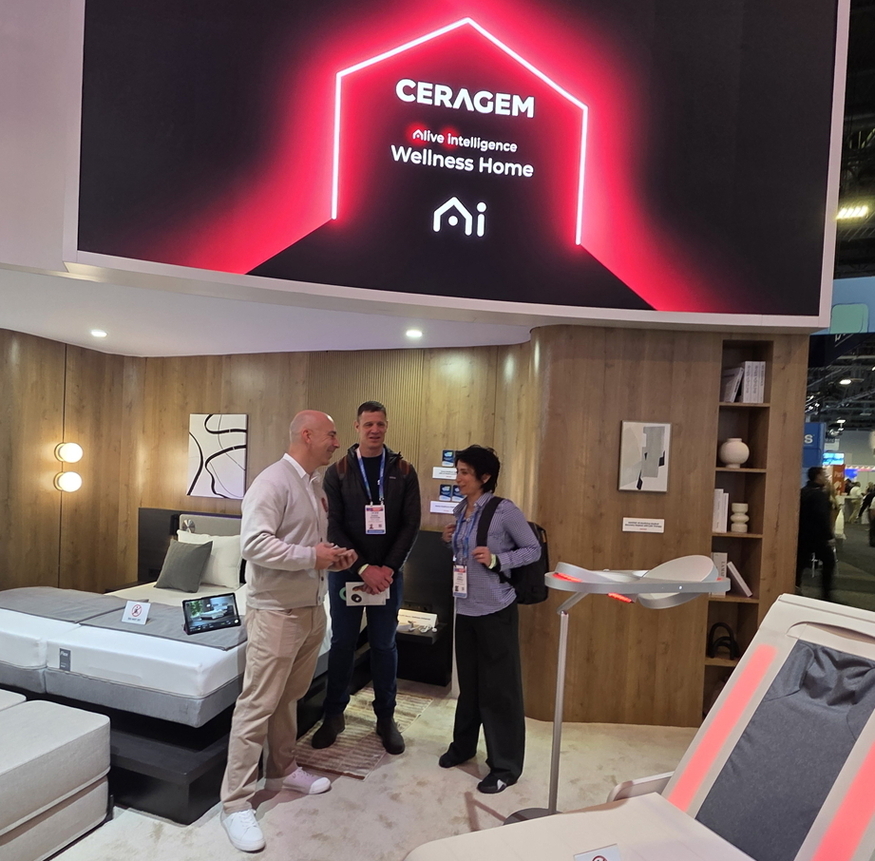
At this year’s Consumer Electronics Show, where smart appliances and AI-powered gadgets filled cavernous exhibition halls, South Korean wellness company Ceragem offered a different vision of the future. It was not just about smarter devices, but about a smarter home—one that senses, responds and actively manages the health of its occupants.
Ceragem, which began 27 years ago as a medical-device manufacturer, unveiled what it calls an “AI Wellness Home” at CES 2026, positioning itself apart from traditional consumer electronics giants pursuing smart-home strategies focused on convenience and connectivity. The company’s concept reframed housing itself as a personalized healthcare platform, powered by artificial intelligence and biometric data.
Branded under the theme “A Home That Knows You Best,” Ceragem’s exhibition showcased a living environment embedded with sensors and AI systems capable of continuously monitoring residents’ physiological signals. Those inputs are analyzed in real time to adjust lighting, temperature, therapy programs and wellness routines—an approach the company describes as hyper-personalized, preventive healthcare delivered through everyday living.
Throughout the exhibit, Ceragem demonstrated how its so-called “seven-care solutions”—spine, circulation, movement, rest, nutrition, mental health and beauty—could be woven seamlessly into the home. The message was clear: the company is seeking to move beyond its legacy identity as a massage-chair brand and reposition itself as a data-driven healthcare services provider.
One of the most crowded attractions was the “Home Therapy Booth 2.0 AI.” As visitors stepped inside, AI cameras assessed facial tone while sensors embedded in the chair instantly measured heart rate and stress levels. Within seconds, the booth adjusted its lighting to calmer hues and initiated a targeted spinal thermal massage. Ordinary activities—watching television, showering, resting—were presented as opportunities to collect health data and deliver tailored care.
Visitors lingered not over isolated gadgets, but over how healthcare devices were integrated into specific living spaces such as the living room, bedroom, bathroom and children’s rooms. Ceragem organized its pavilion into three lifestyle zones: a focus-and-recharge space, an energy-for-daily-life zone, and a stability-and-care area. Each zone illustrated how the AI wellness home could evolve with age, health conditions and lifestyle changes.
The display reflected life stages from childhood through working adulthood to senior living. Products included the “Master AI Multi Therapy Pod,” which delivers personalized wellness programs; the “Medispa Pro All-in-One” home beauty device; the high-end “Therapier” sauna booth offering multisensory therapy; and an AI-powered shower system that analyzes skin condition and automatically adjusts water and care solutions.
Particular attention was drawn to the stability-and-care zone, designed for older adults in their 70s and 80s. This area featured medical devices aimed at both physical and emotional well-being, including a circulation-improving medical chair, an AI-powered water system managing hydration, nutrition and medication routines, a home medical care bed, and a depression-treatment device branded “Mind Fit.” Together, they underscored Ceragem’s ambition to integrate physical health management with mental care inside the home.
By the end of the tour, Ceragem appeared to have shed its long-standing image as a single-product wellness brand. Instead, it presented itself as a provider of future-oriented living solutions, combining AI, healthcare technology and residential design into a unified ecosystem.
“AI should not remain a distant or abstract technology,” said Lee Kyung-soo, Ceragem’s chief executive, at the show. “We wanted to demonstrate how AI can understand users and coexist with them in everyday life. Our AI Wellness Home sets a new standard—one where the home itself designs and completes your health.”
The market appears to be taking notice. Ceragem collected 12 CES Innovation Awards this year, doubling its tally for the third consecutive year. After earning three awards in its CES debut in 2024 and six in 2025, the company’s expanding recognition mirrors its broader ambition: to redefine what a home can do in an era increasingly shaped by data, longevity concerns and preventive healthcare.
At a trade show dominated by screens and processors, Ceragem’s exhibit suggested a quieter, more intimate future—one in which technology fades into the walls, and the home itself becomes a living partner in health.