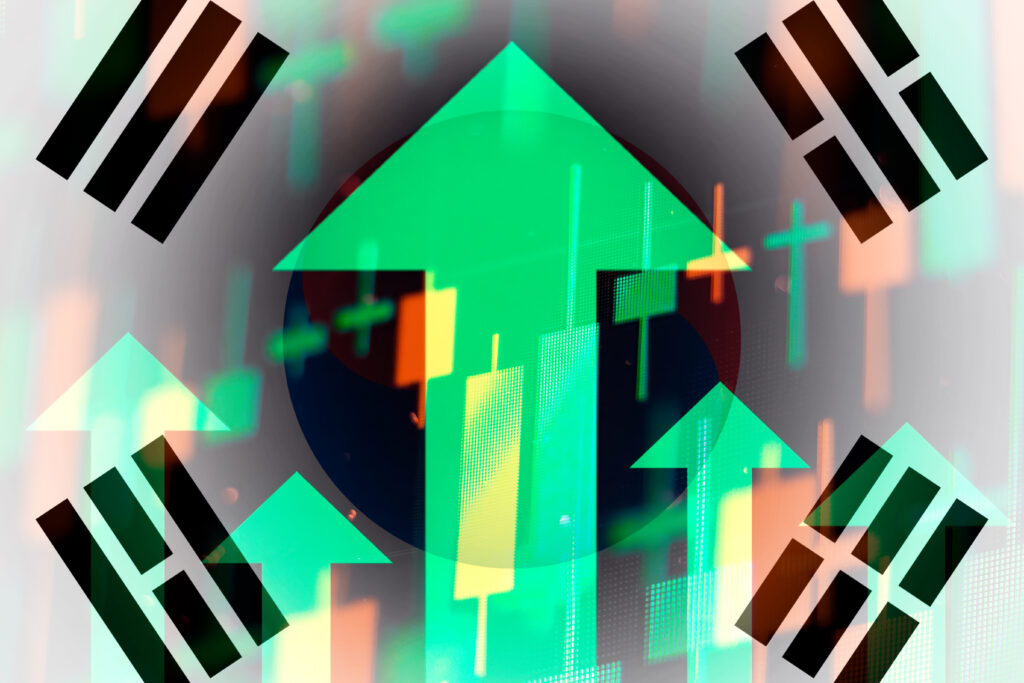
South Korea’s benchmark Kospi index could advance to as high as 5,200 points this year as improving earnings momentum—led by the semiconductor sector—supports further gains, according to a market strategist.
In a report released Monday, Han Ji-young of Kiwoom Securities said the current rally still has room to run, citing the likelihood of additional upward revisions to corporate earnings forecasts, particularly among chipmakers.
“Given the potential for further upgrades to earnings expectations, especially in semiconductors, it is reasonable to leave the upside target open at around 5,200 points,” Han wrote. That level would imply a forward price-to-earnings ratio of roughly 12 times.
The Kospi ended last year near 4,200 and has gained nearly 6% in the first two trading sessions of the new year, quickly pushing past the 4,400 mark. The rally has been supported by strong foreign investor inflows, analysts say.
Han compared the current surge with the powerful bull market of 2020 and early 2021, when South Korean equities rallied sharply following the U.S. presidential election. In January 2021, the Kospi rose nearly 10% in a single week, reaching the 3,000 level for the first time.
That rally, however, lost momentum as early as the second week of January amid concerns over overheating and profit-taking. Between January and July of that year, the index gained just under 5%, raising questions over whether a similar trajectory could limit the upside this time.
“If the current rally follows a comparable pattern, achieving a ‘5,000-plus’ Kospi may prove challenging,” Han cautioned.
She argued, however, that key structural differences distinguish the current cycle. The earlier bull market was driven largely by retail investors, while the present rally is being led by foreign capital. More importantly, she said, the earnings cycle now appears to be at an early stage rather than approaching maturity.
“From a fundamentals perspective, corporate earnings growth was already in the mid-to-late phase of its cycle during the previous rally,” Han said. “By contrast, the current earnings cycle is still in its early phase.”
Han also pointed to stronger-than-expected earnings momentum among South Korea’s major semiconductor companies. She said fourth-quarter results from Samsung Electronics and SK Hynix are likely to exceed expectations, supported by rising memory prices, a favorable shift toward higher-value products, and valuation spillovers from U.S. peer Micron Technology, whose shares have recently traded at record highs.
Following the earnings season, Han expects full-year operating profit forecasts for semiconductor stocks to be revised higher. Current consensus estimates put operating profit this year at around 98 trillion won ($74bn) for Samsung Electronics and 85 trillion won for SK Hynix. Several global investment banks, including JPMorgan, Citi and Nomura, have published projections closer to 150 trillion won for each company.
Despite the recent rally, the Kospi’s forward price-to-earnings ratio stands at about 10.2 times, close to its long-term average. Han said that leaves room for further valuation expansion if earnings momentum continues.
“In previous bull markets underpinned by strong earnings growth, the Kospi has re-rated to between 12 and 13 times forward earnings,” she said. “Against that backdrop, an upside target of around 5,200 points remains justified.”