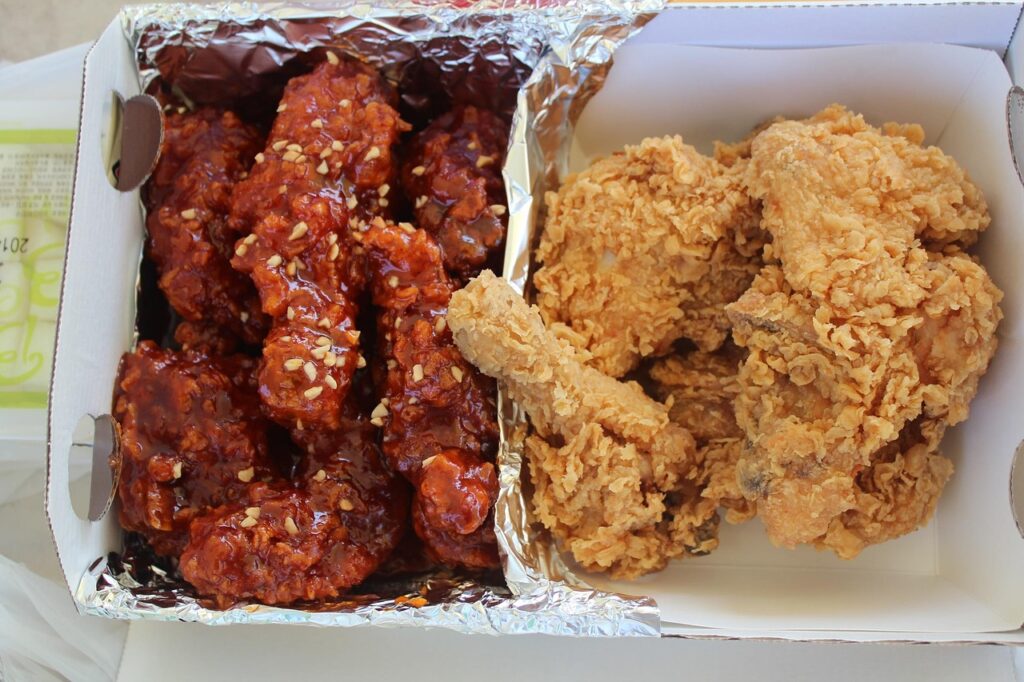
South Korea’s love affair with fried chicken has reached a symbolic peak: the number of franchise chicken outlets nationwide surpassed 30,000 for the first time last year, a milestone that highlights the industry’s enormous scale—and signals that the market is now overcrowded and nearing its limits.
According to government franchise statistics, the country ended 2024 with 31,397 franchise chicken restaurants, a 5.3% increase from the previous year. The rise marks a rebound after several years of slowing growth and caps a steady expansion that began well before the pandemic. Since 2018, when franchise chicken stores first exceeded 25,000, the industry has added more than 6,000 locations—roughly 1,000 new outlets a year.
The growth pace reflects how integral fried chicken has become to daily consumption in South Korea, where dense urban living and app-based delivery have reshaped eating habits. But behind the rising store count, signs of saturation are growing unmistakable.
Competition at the top remains fierce. BBQ regained the No. 1 position last year with 2,316 locations, overtaking bhc, which fell to second after closing dozens of stores. Kyochon Chicken held third place with 1,361 outlets. Meanwhile, the total number of chicken brands declined, pointing to consolidation as weaker players exit an increasingly unforgiving market.
Revenue growth is also losing steam. Franchise chicken sales reached $6.1 billion in 2024, up 7.3% from a year earlier. That increase lagged behind other major dining segments, including coffee chains and casual Korean restaurants. Average revenue per franchise rose less than 2%, indicating that new stores are slicing up existing demand rather than expanding the overall market.
Employment figures further reflect the mounting pressure. Franchise chicken restaurants employed about 65,000 workers last year, down from the previous year, averaging just over two employees per store. Many locations are small, family-run operations that rely on lean staffing to cope with rising costs and steep delivery-platform fees.
The broader market paints a clearer picture of contraction. When independent restaurants are counted alongside franchises, the total number of chicken eateries nationwide has fallen for three consecutive years. As of 2023, South Korea had nearly 3,000 fewer chicken shops than in 2020, even as franchise locations continued to climb. Industry analysts widely describe the domestic market as saturated, where further expansion risks eroding already thin margins.
With growth at home increasingly constrained, major chains are looking abroad. BBQ has accelerated its international push by setting up a European headquarters in Spain, opening its first U.S. drive-through store, and re-entering China—a sign that South Korea’s fried chicken boom may now depend on capturing appetite beyond its own borders.