South Korean food companies are ramping up their Middle Eastern expansion, leveraging President Lee Jae-myung’s state visit to the United Arab Emirates to deepen partnerships with local distributors and capture surging demand for K-food.
CJ CheilJedang said Wednesday that it signed a memorandum of understanding with Al Khayatt Investments, a major consumer-goods distributor in the UAE, during the Korea-UAE Business Roundtable held Tuesday in Abu Dhabi. Under the agreement, the companies will cooperate on product distribution and broaden CJ’s reach across key Middle Eastern retail channels.
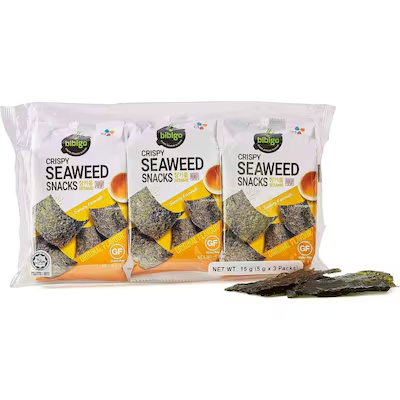
CJ plans to focus on expanding sales of its halal-certified Bibigo seaweed chips and Bibigo stir-fried noodles, with a longer-term goal of widening its product lineup and scaling into neighboring markets. CJ CheilJedang entered the Middle East in 2015 and now operates in eight countries across the region.
Samyang Foods Vice Chairman Kim Jung-soo also attended the roundtable. The instant-ramen maker has rapidly grown its footprint since signing a distribution deal with Sharjah General Trading in 2021. Regional sales, which stood at roughly $18 million at the time, doubled to about $36 million last year and are projected to reach $48 million in 2024. The company plans to further expand distribution of its global hit Buldak (“Hot Chicken”) brand next year and launch an additional international label called MEP.
The Middle East is emerging as a strategic high-growth market for Korean food companies thanks to its young population, rising middle-class consumption, and position as a cultural and logistical bridge across Islamic, South Asian and North African markets. Demand for Korean food has accelerated sharply in recent years.
According to South Korea’s Ministry of Agriculture, Food and Rural Affairs, exports of Korean agricultural and food products to the six Gulf Cooperation Council (GCC) countries totaled $157.2 million from July through October, up 23.5% from a year earlier — underscoring the region’s growing appetite for K-food.