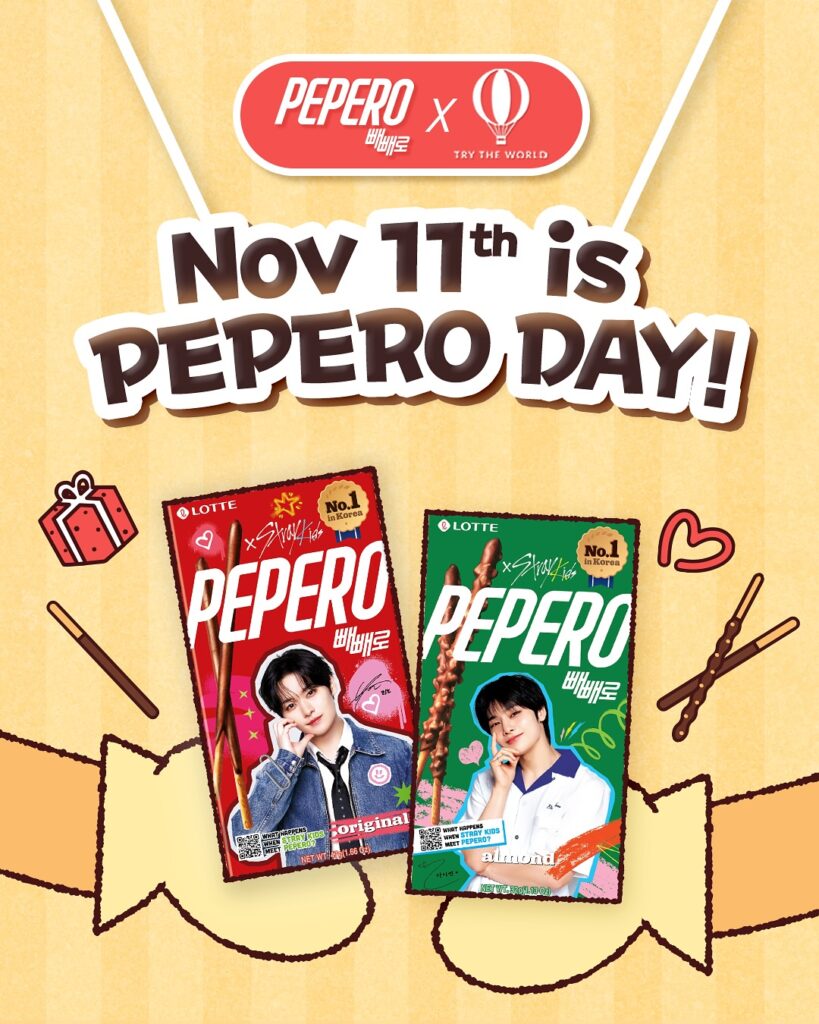
South Korean food giant Lotte Wellfood has found a new recipe for global success: blending a beloved local snack with the unstoppable force of K-pop. Sales of its chocolate-covered biscuit stick Pepero are projected to hit a record $167 million this year, a result not only of strong demand at home but also of the brand’s growing presence abroad.
Pepero’s rise reflects a larger shift in how Korean companies are using cultural exports to drive business expansion. What began as a lighthearted local custom—exchanging Pepero on November 11, known as “Pepero Day”—has become a marketing engine that rides the momentum of Korean pop culture around the world.
Since 2020, Lotte has run global campaigns to promote the tradition, positioning Pepero as part of the broader “K-lifestyle.” This year, the company tapped Stray Kids, one of the world’s most popular K-pop groups, as its global ambassadors. Their appearances in TV ads, subway events, and outdoor billboards helped turn Pepero Day into a viral celebration shared across social media.
At home, Pepero’s special-edition products featuring Stray Kids sold out at Lotte Mart’s Zettaplex in Seoul, while the company’s “Agent:P” ambassador program invited fans from around the world to Korea to create promotional content at landmarks like Gyeongbokgung Palace and Lotte World Tower.
Lotte’s efforts are part of a long-term strategy to turn Korean consumer brands into “global mega brands.” During a Korea-Japan strategy meeting last year in Warsaw, Lotte Chairman Shin Dong-bin called for greater cross-border collaboration to build snack brands capable of generating over 1 trillion won ($730 million) in overseas revenue.
To support that ambition, Lotte opened a new Pepero production line in Haryana, India, in July, enabling the company to serve South Asian and Middle Eastern markets directly.
For American readers, Pepero may resemble Japan’s Pocky, but its story is distinctly Korean—a mix of smart branding, cultural confidence, and the global power of fandom. For Lotte, it’s proof that South Korea’s cultural wave isn’t just reshaping entertainment—it’s redefining how the country’s companies compete on the world stage.